
KAMPALA – Across Uganda this week, thousands of young men and women who recently guarded polling stations during the country’s presidential and general elections have returned to classrooms, this time not to enforce security, but to secure their own futures.
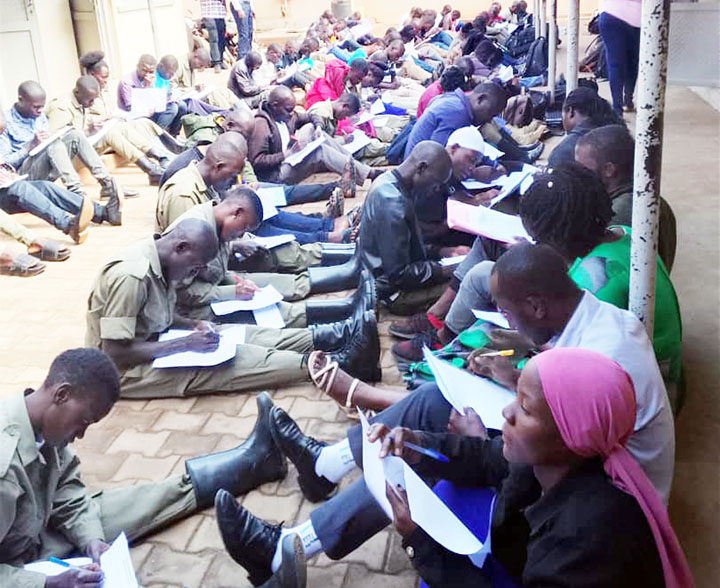
At regional police headquarters from Kabale to Gulu, Election Special Police Constables are sitting written examinations that could determine whether they transition into Uganda’s expanding private security industry after their short-term government contracts expired.
For many of them, the tests represent more than a recruitment exercise. They are a crucial gateway between temporary election duty and the possibility of stable employment in a sector that now guards some of the country’s most vital institutions.
The tests, held at regional police headquarters, began on Monday, March 2, and conclude on Friday.
For many of the constables, it marks the uncertain end of a short but intense chapter in public service.
More than 90,000 Election Special Police Constables were recruited on temporary contracts to help secure polling stations and maintain order during the elections. Their contracts, however, lasted only two months. As they now prepare to be decommissioned, many are looking for a way to carry their skills into longer-term employment.
The new initiative, organized jointly by the Uganda Police Force and the Uganda Private Security Association (TUPSA), is designed to create that bridge.
“The screening and recruitment exercise of Election Constables to join the Private Security sector has been undertaken between the Uganda Private Security Association and the Uganda Police Force through its countrywide command and management structures,” said Grace Matsiko, chairman of TUPSA.
The programme is being conducted under the direction of Inspector General of Police Abbas Byakagaba, through the Police Directorate of Human Resource Development and Training.
The idea, Matsiko explained, is not simply to offer jobs but to channel trained manpower into an industry that already plays a critical role in the country’s security landscape.
“As the umbrella body of private security companies, taking up Election Police Constables is one way of supporting the government’s programme of job and wealth creation while we, as a sector, contribute to enhancing domestic security,” he said.
Behind the initiative lies a deeper concern: what happens when tens of thousands of trained but unemployed young people suddenly find themselves without work?
“It couldn’t have been accidental but a thought-through process by Uganda Police leadership and the government,” Matsiko said. “Rather than having these young and energetic Election Constables become redundant at the end of the election season, those willing are absorbed into the private security sector to avoid some engaging in less productive activities, and in some cases crime.”
The recruitment process is only the first step. Those who pass the written exams will undergo a month of additional training designed specifically for private security operations. The training will build on the basic policing skills they already acquired during their election deployment.
“We are grateful that the Uganda Police is deploying its expertise in working with us as a sector to take up these young men and women into a one-month rigorous training to bolster the private security ranks and files,” Matsiko said.
After training, the newly qualified guards will be randomly deployed to private security companies that have already committed to absorbing them.
The initial phase aims to recruit about 11,000 personnel by the end of March, with further training rounds expected later, depending on available funding.
The stakes are significant.
Uganda’s private security industry already employs more than 100,000 people, the majority of them young workers tasked with protecting a wide range of assets, from banks and hotels to embassies, telecommunications networks, and oil and gas infrastructure.
In many ways, the sector has become an essential layer of Uganda’s broader security architecture.
For the young constables hunched over exam papers this week, the moment felt less like a bureaucratic process and more like a crossroads.
Just weeks ago, they stood watch over ballot boxes and voters. Now they are competing for a place in an industry that could shape their livelihoods long after the election banners have come down.
If the programme succeeds, it may offer something more than temporary employment.
It could turn a short-term electoral deployment into the beginning of a career.