
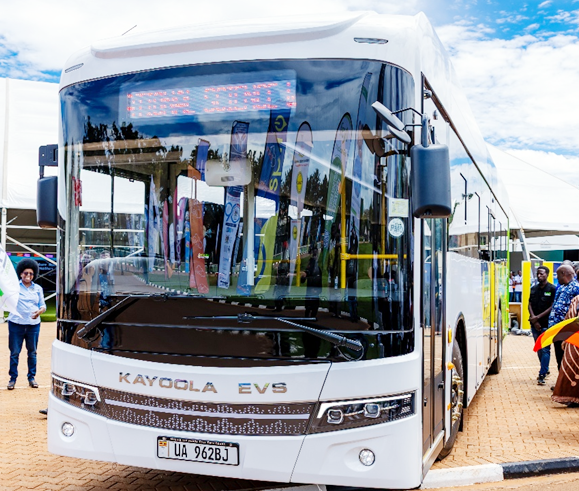
The promise is tangible: better journeys and jobs for Ugandans. Kiira’s electric buses offer a more comfortable journey at a lower fare for commuters worn down by crowded taxis and the daily struggle to cross Kampala. Behind that everyday improvement lies a much bigger test. Uganda is investing in buses to move its people, but also in an industry it hopes will create jobs, develop local skills and eventually sell vehicles beyond its borders. Whether Kiira Motors can deliver on those ambitions at a sustainable cost is drawing scrutiny from Parliament and the Auditor General.
Eight Kayoola electric buses were launched in Kampala in May 2026, followed by another 21 deployed in Kira Municipality in August. The government, working through Kampala Capital City Authority and the Ministry of Works and Transport, has set a target of 300 electric buses operating in Kampala by 2027.
The value of that expansion will depend on whether buses become a dependable part of passengers’ journeys. For taxpayers, the question is what the country gets from an investment that Kiira management puts at Shs486.4 billion by August this year.
Based in Jinja, Kiira Motors was operationalised in 2018 to develop sustainable transport, transfer technology and help establish a local automotive manufacturing industry. The government holds the company’s shares, apart from a four per cent stake held by Makerere University.
Its progress has been uneven. Buses are being produced and deployed, but funding shortages, production costs and weak revenue have complicated the move from vehicle assembly to large-scale manufacturing.
One dispute centres on how much a locally produced bus actually costs.
During scrutiny by Parliament’s Committee on Commissions, Statutory Authorities and State Enterprises (COSASE), lawmakers questioned the Shs20 billion allocated to producing 25 Kayoola electric buses. The initial estimate of about Shs800 million per bus prompted questions about why local assembly appeared to cost more than importing complete electric vehicles.
Management said that the calculation included more than the vehicles. Some of the money paid for equipment and infrastructure needed to produce them.
“While the money goes into the production of buses, there are certain things which don’t go into the bus. For us to produce in Nakasongola, there are some tools we buy because that plant wasn’t set up for that purpose,” management told the committee in response to questions from Buzaaya County MP Martin Muzaale.
The distinction is important because equipment bought to establish production can serve more than one batch of buses. But the explanation still leaves taxpayers with a question about the cost of each vehicle once those initial investments are separated out.
Revenue presents another challenge. In the 2023/24 financial year, Kiira projected Shs197.49 billion but collected Shs2.345 billion, about 1.2 per cent of its target. Put simply, it brought in roughly Shs1.20 for every Shs100 it expected.
Vehicle sales accounted for Shs1.63 billion, while charging and related services generated Shs35 million. The Auditor General attributed the poor performance partly to inadequate capitalisation: the company lacked some of the funding it needed to develop its operations.
That difficulty continued in 2024/25. Kiira requested Shs166.64 billion to fully operationalize the Jinja plant, but the government initially approved Shs32.5 billion, leaving a Shs134.14 billion gap.
Parliament’s Presidential Affairs Committee later recommended additional funding to support commercialization, mass production and wider electric transport infrastructure. The gap was not fully closed, however, leaving the company trying to meet ambitious targets with fewer resources than it had requested.
Management says production is nevertheless growing. Chief executive Paul Musasizi says Kiira has produced 100 buses, with another 15 on the production line, and expects more than 300 buses to be on the road by the end of the year. The government has separately set its target of 300 buses operating in Kampala by 2027.
The 2026/27 Budget Speech offered another measure of progress: reported bus sales of Shs21.6 billion and orders for 450 buses from Uganda and the region. These figures describe a later stage of the company’s development than the 2023/24 revenue results.
“Despite being in its early stages of operation, Kiira Motors has already made bus sales worth Shs21.6 billion and received orders for 450 buses from Uganda and the region. The quality and reliability of its products were further demonstrated through the successful ‘Pearl to Cape’ electric expedition, during which the Kayoola Electric Bus traversed more than 13,000 kilometres across Africa”, said Henry Musaasizi, State Minister for Finance, Planning and Economic Development.
Orders point to demand, but the next test is turning them into vehicles delivered and paid for. Employment figures also suggest expansion, although they cover different dates.
By 2024, the Auditor General recorded 155 employees against an approved structure of 247 positions. Management reported recruiting another 47 staff by 2025. Musasizi now puts the workforce at 443.
At full capacity, the plant’s initial target of 2,500 vehicles a year would require about 900 workers, the company said. Its eventual ambition of 10,000 vehicles annually would require more than 2,000. These are potential jobs tied to future production, rather than positions already filled.
Aminah Mukalazi, Minister of State for Privatization and Investment, said the factory was already providing work for Ugandans.
“I saw many Ugandans employed, from those cutting metal up to the real car. This is a very big factory; the government supports it, and it is going to go forward. We’re going to continue, as the Ministry of Finance, to make it to a good standard, and other factories that do such things.”
Kiira also wants a greater share of each vehicle to be made locally. Its long-term target is 65 per cent local content by 2040, including steering systems, drive axles, tyres, engines and motors. Achieving that would extend the industrial benefits beyond the assembly plant to component suppliers.
“We hope that by 2040, 65 per cent of that will be made locally,” said the CEO.
The ambitions extend to batteries. Kiira has outlined a 10-year strategy estimated at Shs33.4 trillion to develop an electric-vehicle battery industry, including components, cells and packs. That is a proposed industrial programme, separate from the Shs486.4 billion management says has already been invested in the company.
To secure demand, Kiira is seeking a 10-year government purchase agreement covering 3,000 buses, 1,500 pickups and 600 sport utility vehicles. Management says a guaranteed domestic market would help it build a record that could support entry into export markets.
Such an agreement would give the manufacturer greater certainty. It would also make government purchasing central to the company’s growth, sharpening the need to demonstrate value for public money.
Some public agencies have already adopted its buses. Joel Bameka, senior transport officer at the Uganda Civil Aviation Authority, linked the authority’s decision to innovation and environmental sustainability.
“As the Civil Aviation Authority, one of our core values is innovation, and with innovation you have to embrace technological advancement that comes with continuous improvement as you look to have a competitive advantage against the fast-changing industry, and worldwide electric vehicles are the way to go and they come with environmental cleanliness as part of enhancing sustainability so we’re very happy with the Kiira Motor products,” he said.
Kiira has also partnered with private companies, including MTN Uganda, to promote electric mobility.
“It is truly inspiring to see how we can be able to partner together leveraging of technology to enable electric mobility. The standard of the quality of the buses and the quality of the work that is being done by the team really exemplifies excellence and truly shows that Uganda is on the path of driving digital progress for Africa,” said Sylvia Mulenge, CEO of MTN Uganda.