
Close Menu
C-News
  • News
    • World
  • Politics
  • Business
    • Technology
    • Careers
  • Lifestyle
    • Entertainment
    • Travel
  • World News
  • Sports

Subscribe to Updates

Get the latest creative news from FooBar about art, design and business.

What's Hot

Why Uganda’s electric vehicle revolution is slowing down

July 29, 2026

UETCL, UEDCL: Kampala’s Blackouts May Soon Be History

July 23, 2026

Uganda’s Biggest Export Problem? Finding Buyers. Here’s Why.

July 23, 2026
Facebook X (Twitter) Instagram
Trending
  • Why Uganda’s electric vehicle revolution is slowing down
  • UETCL, UEDCL: Kampala’s Blackouts May Soon Be History
  • Uganda’s Biggest Export Problem? Finding Buyers. Here’s Why.
  • What 27,000 Clients Say About the World Bank
  • Is Uganda Spending on What Matters? Makerere Opens Budget Debate
  • Minister Balaam Crackdown Puts PDM Under Pressure
  • Balaam Tours: RDCs Put on Notice Over Failed Project Corruption
  • Can a Shs 1.3m per kilo Coffee Sale Change What Ugandan Farmers Earn?
X (Twitter)
C-News
  • News
    • World
  • Politics
  • Business
    • Technology
    • Careers
  • Lifestyle
    • Entertainment
    • Travel
  • World News
  • Sports
C-News
Home»News»MPs Push to Reintroduce Minimum Wage of Shs 500,000
News

MPs Push to Reintroduce Minimum Wage of Shs 500,000

By C-News Bureau ChiefApril 24, 2024No Comments3 Mins Read
Facebook Twitter Pinterest LinkedIn Tumblr Email
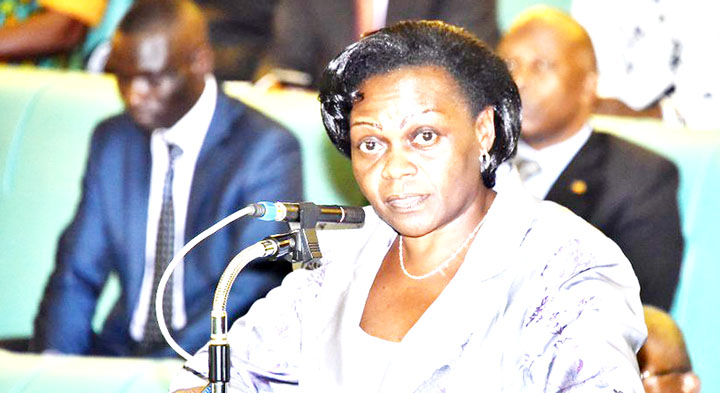
Sarah Opendi, representing the state minister for labor, highlighted a cultural challenge related to savings among Ugandans, noting that many only save for short-term gains, such as end-of-year festivities.
Share
Facebook Twitter LinkedIn Pinterest Email

C-News Bureau Chief

KAMPALA – Legislators are poised to accelerate the reintroduction of the minimum wage bill, a development announced during a specialized training session for the Parliamentary Forum on Labour, Decent Employment, and Productivity held in Entebbe.

Initially passed by Parliament in February 2018, the Minimum Wage Bill of 2015 aimed to introduce a structured mechanism for setting minimum wages across various economic sectors.

As detailed on the Parliament website, the legislation intended to create minimum wage boards appointed by the minister. These boards were tasked with determining sector-specific minimum wages and were empowered with specific duties, functions, and procedural responsibilities for wage determination.

The bill, championed by Workers MP Arinatwe Rwakajara, was designed to rectify deficiencies in the existing Minimum Wage Advisory Board Act by establishing a framework for both employee and employer-led minimum wage determination that would be applied across different sectors.

However, the bill faced a significant setback when President Museveni, following recommendations from then-Attorney General William Byaruhanga, vetoed the bill. In a letter dated August 21, 2019, addressed to then-Speaker of Parliament Rebecca Kadaga, President Museveni returned the bill without his assent, stalling its progress. This move highlighted the complexities and challenges of legislative reform in the area of wage regulation in Uganda.

In an interview for this article, Bugahya County MP Pius Wakabi emphasized the urgent need to address the issue of minimum wage in Uganda. “We need to bring up the issue of the minimum wage because you will find that most employees are being paid as little as Shs100,000 a month. That is so little that somebody cannot even survive. That means that he earns less than a dollar per day,” Wakabi explained. He advocates for a minimum wage where the least an employee should earn is Shs 500,000, acknowledging that while Uganda has robust laws, their implementation remains a significant challenge.

Sarah Opendi, representing the state minister for labor, highlighted a cultural challenge related to savings among Ugandans, noting that many only save for short-term gains, such as end-of-year festivities, rather than long-term financial security. She also pointed out the rampant exploitation of workers, particularly in the private sector, due to the absence of a minimum wage law. “There were efforts to have the minimum wage dealt with, but these efforts have not yielded any fruit. I hope that very soon we shall have this bill presented, of course as a private member’s bill, so that we can deal with the issue of the minimum wage to do away with the exploitation of Ugandans,” Opendi said.

Opendi also noted the potential for mandatory savings schemes as a solution to help alleviate some of the economic challenges faced by Ugandans. During the meeting, legislators expressed concern over the lack of supervision and the unsafe conditions in which Ugandans are employed, particularly in factories, where safety gear is often not provided unless there is a strike or a severe accident.

Berivan Erbil Pamuk, a decent work and social protection expert at Enable Belgian Development Agency, defined decent work protection as essential for preventing vulnerability, social exclusion, and poverty throughout people’s lives. “Social protection includes non-contributory schemes, contributory schemes, and labor market policies from the state because it can influence labor market integration for job seekers,” she stated, highlighting the broader implications of social protection measures on national growth.


Top of Form


Share. Facebook Twitter Pinterest LinkedIn Tumblr Email
C-News Bureau Chief
  • Website

Related Posts

Why Uganda’s electric vehicle revolution is slowing down

July 29, 2026

UETCL, UEDCL: Kampala’s Blackouts May Soon Be History

July 23, 2026

Is Uganda Spending on What Matters? Makerere Opens Budget Debate

July 21, 2026
Top Posts

Opening Ceremony FIFA World Cup Qatar 2022

November 21, 2022

Musk lifts Donald Trump’s Twitter ban after a poll

November 23, 2022

Angry protests at giant iPhone factory in Zhengzhou

November 26, 2022

Protesters openly urge Xi to resign over China Covid curbs

November 27, 2022
Don't Miss
News

Why Uganda’s electric vehicle revolution is slowing down

By ROBERT SPIN MUKASAJuly 29, 20260

Ugandans are ready to embrace electric vehicles, but high upfront costs, limited charging infrastructure and scarce financing threaten to slow the transition. New research suggests affordability, not demand, is the biggest hurdle.

UETCL, UEDCL: Kampala’s Blackouts May Soon Be History

July 23, 2026

Uganda’s Biggest Export Problem? Finding Buyers. Here’s Why.

July 23, 2026

What 27,000 Clients Say About the World Bank

July 22, 2026
Stay In Touch
  • Twitter

Subscribe to Updates

Get the latest news from c-news!

Demo
About Us
About Us

C-News is your source of the latest general news, business, health, travel and politics as it breaks in Uganda and East Africa.

Reports, Analysis, Pictorial and Videos.

Email Us: info@c-news.ug
Contact: +256 776745120

X (Twitter)
Our Picks

Why Uganda’s electric vehicle revolution is slowing down

July 29, 2026

UETCL, UEDCL: Kampala’s Blackouts May Soon Be History

July 23, 2026

Uganda’s Biggest Export Problem? Finding Buyers. Here’s Why.

July 23, 2026
Most Popular

Opening Ceremony FIFA World Cup Qatar 2022

November 21, 2022

Musk lifts Donald Trump’s Twitter ban after a poll

November 23, 2022

Angry protests at giant iPhone factory in Zhengzhou

November 26, 2022
  • Home
  • Privacy Policy
© C-NEWS 2026

Type above and press Enter to search. Press Esc to cancel.