
KAMPALA – “Are we putting our money where our heart’s desires are?”
That was the question Dr Jude Ssempebwa posed as Makerere academics gathered to examine Uganda’s 2026/27 budget, not simply as a collection of figures, but as a test of what the government considers important.
After the national budget was presented on June 11, Dr Jude Ssempebwa was left with the same question troubling many citizens: is the government spending public money on the things that matter most?
“Is it the best budget we could have? Are we putting our money where our heart’s desires are?” he asked.
Ssempebwa, the chairperson of the Makerere University Academic Staff Association, argues that those questions should not be left only to politicians, government officials and social-media commentators. Universities, he says, must also help Ugandans understand what the budget promises, what it leaves out and whether it can deliver the development the country expects.
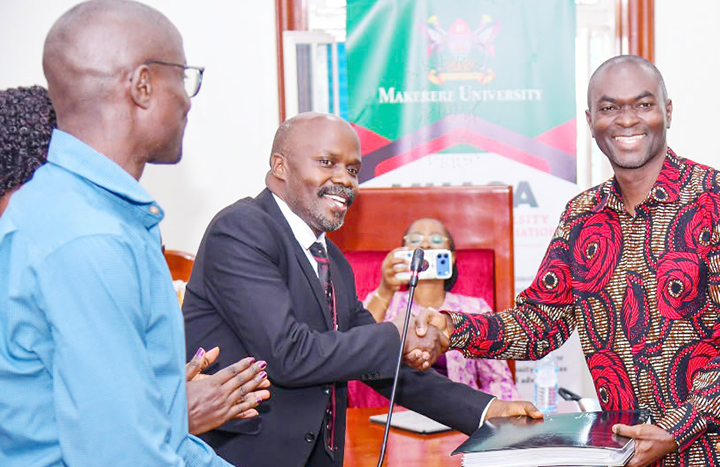
MUASA has now launched what it plans to make an annual National Budget Breakfast Meeting, bringing academics, policymakers and financial-sector leaders together to examine Uganda’s 2026/27 spending plan.
The inaugural dialogue marked an attempt to return Makerere University to a more visible role in national debate. It also became a platform for university leaders to press the government for greater investment in higher education, better pay for academic staff and approval of Makerere’s revised staffing structure.
“The objective of this meeting is to promote appreciation and critique of the national budget through the lenses of the National Development Plan, the Strategic Development Goals and an internationally comparative perspective,” Ssempebwa said.
“Hopefully, the meeting will contribute to efforts to enhance the budget’s performance, stakeholder participation, and the quality of future budget processes.”
A national budget is more than a table of revenues and expenditures. It determines which roads are built, how hospitals are supplied, whether schools recruit enough teachers and how much support farmers, businesses and local governments receive. The budget’s success is measured not by the size of the figures announced in Kampala, but by whether public services improve and household incomes rise.
Ssempebwa said the June budget presentation had left several questions unanswered, including why salary enhancements for senior lecturers, lecturers and assistant lecturers did not appear in the spending plan.
“Is the joy the budget gave well-deserved? Is the pain the budget gave expedient?” he asked. “Why was money for enhancement of the salaries of Senior Lecturers, Lecturers, and Assistant Lecturers nowhere to be seen in the budget?”
Although Parliament, businesses and the public already debate the budget, Ssempebwa said universities can offer something different: analysis grounded in research across economics, public health, agriculture, law, technology and other fields.
“Many members of MUASA are experts in these things,” he said. “Moreover, they are nonpartisan and dispassionate.”
He said the association intends to organise similar discussions on Ebola, the Parish Development Model, human rights, appropriate technology, food security and regional integration.
Makerere Vice Chancellor Professor Barnabas Nawangwe welcomed the initiative as a revival of the university’s historic place in Uganda’s public life.
“A lot of people say Makerere used to be the centre of debate on national issues,” he said, recalling an era when academics such as Mahmood Mamdani debated with national leaders like Milton Obote in the university’s Main Hall.
That culture weakened, Nawangwe said, as lecturers became preoccupied with poor pay and difficult working conditions.
“We were more preoccupied with how we would survive as members of staff because the situation was very difficult,” he said.
He argued that improvements in staff welfare had created room for academics to turn their attention back to national questions. But he also challenged researchers to produce evidence that policymakers can use.
Nawangwe cited the government’s campaign encouraging coffee cultivation as an example. Before farmers are urged to invest their land, labour and money, he said, researchers should establish whether coffee can thrive in every area being promoted.
“Have we studied and concluded that coffee can grow everywhere or are we simply going to make farmers spend their energy and perhaps get nothing out of it?” he asked.
The example captures the practical value of academic scrutiny. A policy may sound persuasive in speech, but without evidence it can expose households to losses. Research can show where an intervention is likely to work, where it may fail and how public money can be used more effectively.
Nawangwe also argued that higher education should be treated as the foundation of Uganda’s economic transformation.
“If you have an educated population, you will have better health, better agriculture and better trade,” he said. “Everything will improve once the population is properly educated.”
He renewed calls for the government to approve Makerere’s revised staffing structure. Under the current arrangement, he said, qualified academics cannot always be promoted to professorial positions because the authorised structure does not provide enough posts.
“We have built so much capacity, but as a country we are not making good use of it,” he said.
Andrew Philip Wabulya, the Bank of Uganda’s executive director for risk and strategy, delivered remarks on behalf of Deputy Governor Professor Augustus Nuwagaba. He said future budgets must respond to climate change, geopolitical tensions, rapid technological shifts and the demands of Uganda’s young population.
He called for investment in infrastructure, manufacturing, agro-processing, climate-resilient agriculture, artificial intelligence and human-capital development.
“Our budget must prioritise sustainability, productivity and inclusivity,” Wabulya said. “The national budget is not merely a financial plan. It is a statement of intent and a reflection of where the nation aspires to be through purposeful investment and responsible spending.”
Professor Edward Baale, principal of Makerere’s College of Business and Management Sciences, similarly described the budget as an expression of the government’s economic philosophy.
He said its goals include creating jobs, raising household incomes and drawing more families into the formal economy through small businesses, value addition and access to finance. But the central test, he argued, is whether existing wealth-creation programmes are capable of reaching everyone.
“What we are asking is, are the existing wealth creation programmes sufficient to move everybody into the money economy?” Baale said.
That question will determine whether the new breakfast meeting becomes more than an academic event. MUASA wants it to develop into a regular forum where government choices are tested against evidence and where researchers explain what official policy means for citizens.