
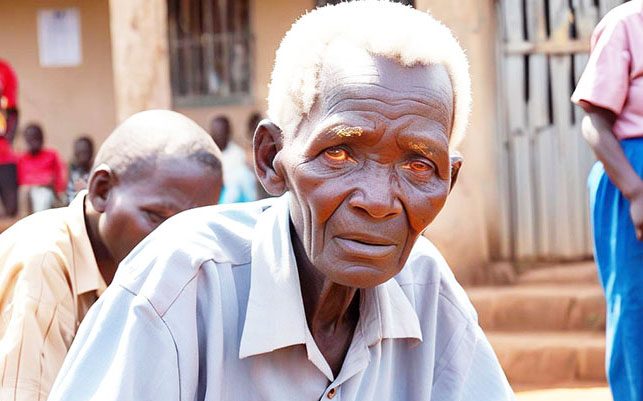
KAMPALA – In a trading centre outside Masaka, an elderly woman opens her stall early in the morning as she has done for decades, arranging tomatoes with careful hands. Her back aches. Her eyesight is failing. There is no pension to fall back on, no regular health checks, no home-based care worker to call. Like millions of older Africans, she is aging in plain sight, working, caring for grandchildren, holding families together, while public policy largely looks the other way.
This quiet reality sits at the heart of a new World Bank report on aging, which warns that the world is entering a demographic moment that will reshape economies, health systems, and social contracts. By 2050, the global population aged 60 and above will more than double to 2.1 billion people. What is often framed as a challenge for Europe, Japan, or North America is now accelerating fastest in places least prepared for it, including sub-Saharan Africa.
Africa remains the world’s youngest continent, but that statistic is becoming dangerously misleading. Older populations here are growing faster than almost anywhere else, driven by longer life expectancy and declining fertility. Uganda is part of this shift. Today’s health and social systems were built for a country battling childhood infections and maternal mortality. They are far less ready for a future dominated by diabetes, hypertension, arthritis, dementia, and the slow erosion of physical independence.
The World Bank’s central argument is simple but urgent: aging is not just about more old people. It is about whether societies can turn longer lives into productive, dignified ones or allow them to become a source of hardship, inequality, and preventable suffering.
Globally, older adults already contribute far more than is commonly acknowledged. Through paid work, farming, childcare, and community volunteering, they underpin economies and households. In the United States, the report notes, the non-market contributions of older adults are valued at more than $20,000 per person each year. In Africa, where formal welfare systems are thin, these contributions are often even more critical, though rarely measured.
Yet health systems remain stubbornly ill-equipped. Most are designed around short-term, acute illness, not the long-term management of chronic conditions that define older age. The report places Primary Health Care at the centre of the solution, arguing that clinics must shift from treating episodes of sickness to supporting people across the life course.
Case studies from around the world show both promise and warning signs. Bangladesh, facing a rapidly aging population, has introduced non-communicable disease units in clinics, but struggles with limited insurance coverage and a shortage of health workers trained in geriatric care. Colombia has constitutional guarantees to health care, yet deep inequalities persist, particularly around pensions and housing, which shape how well people age. Mongolia’s vast distances leave older people isolated from services, exposing the need for stronger links between health and social welfare systems.
In the Gulf, the pandemic forced rapid innovation. Abu Dhabi’s “Population-at-Risk” programme combined telemedicine and home-based care to protect older people during COVID-19—an emergency response that now offers a blueprint for long-term care models beyond hospitals.
Africa’s challenge is sharper. The report describes a looming care gap created by three converging forces: a fast-growing older population, chronically underfunded health systems, and the weakening of traditional family care as young people migrate to cities and women enter paid work. Few African countries, Uganda included, have formal long-term care policies. Care happens by default, not by design.
The danger is that aging becomes a private crisis rather than a shared responsibility. Without support, families absorb the costs, financial, emotional, and physical, pushing households deeper into poverty. Older women are particularly vulnerable, having spent lifetimes in informal work with no pensions and limited access to land or savings.
The report also highlights a less visible problem: data poverty. Many countries simply do not know how older people live, what illnesses they carry, or what care they receive. Without reliable data, policy becomes guesswork. Gender gaps compound the problem, with evidence showing that older, poorer, and socially isolated men are among the least likely to receive care, challenging assumptions about who is most vulnerable.
For Uganda, the implications are stark but not hopeless. Aging policy cannot be postponed until the country feels “old enough.” The systems built today—community health workers trained to manage chronic disease, clinics equipped for long-term care, modest social protection schemes—will determine whether tomorrow’s older Ugandans age with dignity or desperation.
The World Bank’s message is not one of alarmism, but of opportunity. Aging, handled well, can be a demographic dividend. Handled poorly, it becomes a silent crisis. The choice lies in whether governments move from pilot projects to systems, from rhetoric to investment, and from seeing older people as dependents to recognising them as citizens with value, rights, and potential.
Back at the roadside stall, the woman counts her day’s earnings and packs up as the sun sets. She has carried the economy on her back for years. The question now is whether the economy—and the state—are prepared to carry her as she grows older.