
KAMPALA – In Buwama in the central district of Mpigi, the impact of community service can be measured in practical things: a safe place for a girl to sleep, a Braille machine in a classroom, a child getting a better chance to stay in school.
At the Centre for the Visually Impaired Children, those things matter deeply.
The school serves more than 100 learners, but like many specialised institutions in Uganda, it operates under constant pressure, balancing urgent needs against limited resources. For years, girls shared sleeping quarters with boys because there was nowhere else to put them. Even now, the school still has fewer Braille machines than its learners need.
These are not abstract shortages. They shape daily life.
They affect how children learn, how safely they live and how much support families can count on.
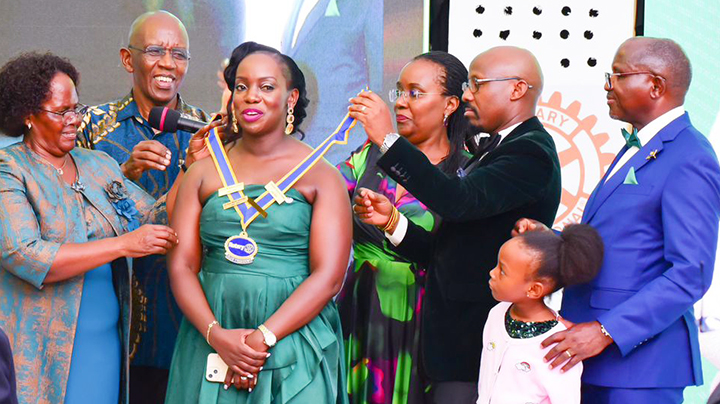
That reality framed the Rotary Club of Buziga’s leadership transition over the weekend.
As members celebrated the completion of a girls’ dormitory and unveiled a new campaign to secure more Braille machines, the evening became about more than changing leadership.
Last Saturday evening, rotarians, community leaders, district officials and guests had gathered for the Rotary Club of Buziga’s Charter Night celebration. But this was more than an annual ceremony. It marked a turning point for one of Rotary District 9214’s younger clubs and for the communities it serves.
Beatrice Sekabembe Juuko was formally installed as the club’s fifth president, becoming the first woman to lead the Rotary Club of Buziga since it was established in 2022.
The leadership transition came after a year that members say reshaped the club’s footprint in practical ways, especially for vulnerable learners.
At the centre of that work was the successful construction and handover of a girls’ dormitory at the Centre for the Visually Impaired Children in Buwama.
The project addressed an immediate and deeply personal challenge. Before the new dormitory was built, girls and boys had been sharing accommodation facilities.
The new building changes that.
It gives female learners safer and more secure living space, more privacy and a stronger sense of dignity at school, changes that can affect concentration, comfort and learning in ways that aren’t always obvious on paper.
For many Ugandan families raising children with disabilities, access to specialised education remains difficult. The barriers are often practical: transport, equipment, accommodation and the cost of care.
That means interventions like a dormitory can become much more than infrastructure.
They can determine whether a child remains in school and how safely they learn.
Outgoing president Gilbert Amanya reflected on that broader meaning as he handed over office.
“Leading a Rotary club is far more than holding a title. It is a commitment to serve, inspire, and guide a team of dedicated individuals united by a common purpose of making a difference in the lives of others,” he said.
His term also included collaborative medical camps along the Gaba Road corridor and the sponsorship of the Rotary Club of Busabala.
But members repeatedly returned to one point during the evening: the work only matters when it reaches communities directly.
“These achievements happened because of the collective effort of dedicated Rotarians who willingly gave their time, resources, ideas, and energy to support the club and its mission,” Amanya said.
As he stepped aside, attention shifted to what comes next.
Juuko took office in a reflective but confident mood, acknowledging both the symbolism of the moment and the responsibilities attached to it.
“I am deeply honored to stand before you tonight as the incoming President of the Rotary Club of Buziga and the club’s first female President, a milestone that makes this moment even more meaningful for me personally,” she said.
Her speech blended gratitude and ambition.
“Leadership is not really about the title someone gives you. It is about the responsibility that comes with people believing in you. That trust is something I do not take lightly.”
For Ugandans, Rotary’s internal transitions may not always draw much attention.
But the projects attached to those transitions often do.
And Juuko’s next major priority could have immediate consequences for dozens of learners.
The club plans to acquire ten additional Braille machines for the Centre for the Visually Impaired Children.
The school currently serves more than 100 visually impaired learners but has only around 40 Braille machines.
That shortage affects classroom access and limits how students read, write and participate.
Closing even part of that gap could improve literacy, strengthen classroom participation and make day-to-day learning easier for children who already navigate barriers many schools are not equipped to handle.
Chief Guest and District Governor Nominee Fabian Kasi called the project transformative.
“This project has the potential to transform lives by giving children the tools they need to learn, grow, and achieve their dreams,” he said.
He also pledged support for the fundraising effort and urged businesses, development partners and supporters to join.
Beyond the school project, the club is planning a broader year built around youth empowerment, stronger community partnerships and expanding membership.
That may sound organisational.
But in practice it affects how much a club can deliver.
A stronger membership base usually means more volunteers, more fundraising capacity and more partnerships.
Youth-focused work through Rotaract also matters in Uganda, where leadership opportunities and skills-building remain urgent concerns for many young people.
There are quieter long-term effects too.
Community organisations like Rotary often fill gaps that public systems alone struggle to reach quickly, especially around specialised education, mentorship and community health.