
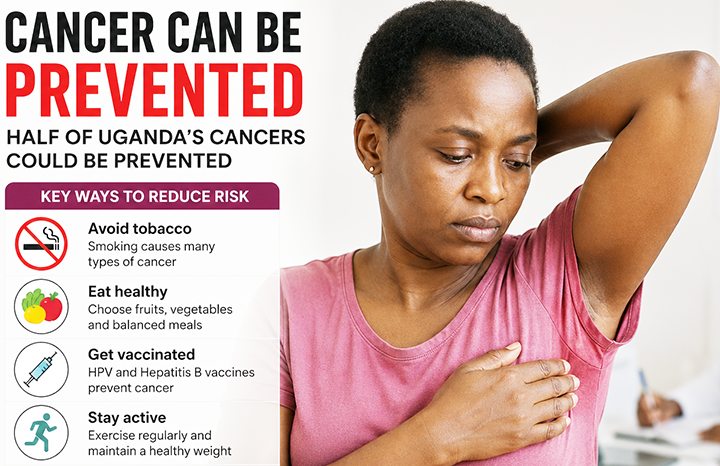
Resty Natalie (not real name) ignored the lump beneath her arm when she first noticed it.
Like many Ugandans, she assumed it was nothing serious. A visit to a neighbourhood herbalist seemed easier, cheaper and less frightening than going to hospital. Months passed. The swelling remained. By the time she sought specialist care at the Uganda Cancer Institute (UCI), doctors diagnosed her with Stage III breast cancer, a point at which treatment becomes far more complex, expensive and uncertain.
Her story is painfully familiar. Across Uganda, thousands of people discover they have cancer only after the disease has silently spread, turning what might have been a treatable condition into a life-threatening one. Yet doctors say many of these cases need not reach that stage at all.
The World Health Organization (WHO) estimates that between 30 and 50 per cent of cancers diagnosed in Uganda are preventable. That means thousands of lives could be saved each year through healthier lifestyles, vaccination, early screening and better environmental protection.
For a country where cancer treatment services remain under immense pressure, prevention has become more than a health recommendation. It is one of Uganda’s strongest weapons against a disease that is steadily claiming more lives each year.
According to the Uganda Cancer Institute, about 35,968 new cancer cases are diagnosed annually, and that number continues to rise. The International Agency for Research on Cancer projects that Uganda could record more than 77,510 new cases by 2040, an increase of approximately 138 per cent if current trends continue.
Behind those figures are families whose savings disappear into medical bills, children forced to care for sick parents, and patients whose chances of survival diminish simply because help came too late.
Doctors say one of the biggest misconceptions is that cancer mainly results from bad luck or genetics. In reality, many of the biggest risks are woven into everyday life.
Tobacco use, excessive alcohol consumption, obesity, poor diets low in fruits and vegetables, and exposure to environmental pollutants all contribute to cancer risk. So too does the growing problem of improperly discarded electronic and industrial waste, which releases harmful substances into the environment.
In Uganda, however, infections remain among the most significant drivers of cancer.
The Uganda Cancer Institute says HIV dramatically increases the likelihood of developing several cancers. People living with HIV face more than a 1,000-fold higher risk of Kaposi sarcoma, more than a 70-fold increased risk of non-Hodgkin lymphoma, and more than a five-fold higher risk of cervical cancer. Nearly three in every 10 cancer patients treated at the institute, 29 per cent, are HIV-positive.
People living with albinism also face exceptionally high risks. More than 80 per cent of patients with albinism who develop skin cancer are younger than 40, underscoring how early and aggressively the disease can strike when adequate protection from the sun is lacking.
Despite these realities, many Ugandans continue to seek medical attention only after cancer has advanced.
That delay is often blamed on more than the disease itself. Limited public awareness, cultural beliefs, inadequate screening services at the community level and the persistent misconception that cancer is either a disease of the wealthy or the result of supernatural forces continue to discourage people from seeking early diagnosis. Yet specialists insist cancer does not discriminate.
Women between the ages of 30 and 60 face particularly high risks of cervical and breast cancers, especially if they have not received the Human Papillomavirus (HPV) vaccine, which protects against the virus responsible for most cervical cancer cases. Cervical cancer remains the most common cancer affecting Ugandan women.
Men are increasingly being diagnosed with prostate cancer and liver cancer, the latter closely linked to chronic Hepatitis B infection.
Lifestyle choices further increase the danger. People who smoke cigarettes, use shisha or chew tobacco face significantly higher risks of cancers affecting the lungs, mouth, throat and oesophagus. Heavy alcohol consumption increases the likelihood of liver and colorectal cancers.
Urbanisation is introducing new threats as well. Rapid industrial growth, poorly regulated factories, contaminated water sources and informal electronic waste dumps expose communities to toxic substances that can accumulate in the body over time and trigger cancerous changes in cells.
For many families, the consequences are devastating. Cancer treatment often requires repeated hospital visits, chemotherapy, surgery or radiotherapy, costs that quickly overwhelm households already struggling with everyday expenses. A single chemotherapy cycle can cost hundreds of thousands of shillings, placing treatment beyond the reach of many Ugandans.
That is why health experts argue that prevention is not only medically effective but also economically sensible.
The same healthy habits that reduce cancer risk also lower the chances of developing diabetes, hypertension and heart disease. Every cigarette not smoked, every vaccination received and every early screening completed represents an investment in longer, healthier lives and lower healthcare costs.
The WHO’s estimate that up to half of cancers in Uganda are preventable is therefore more than a statistic. It is a reminder that many cases can be stopped before they begin.
That starts with individuals making healthier choices: avoiding tobacco, limiting alcohol consumption, eating more fruits and vegetables, maintaining a healthy weight through regular physical activity and ensuring vaccination against HPV and Hepatitis B.
But the responsibility does not end there. Communities and government also have critical roles to play.
Uganda needs stronger systems to manage electronic waste and industrial pollution, stricter enforcement of environmental regulations and wider public education about cancer prevention. Healthcare workers and community health volunteers need greater support to promote early detection, while more women should have access to routine cervical cancer screening through HPV testing.
WHO also calls on governments to continue investing in the Uganda Cancer Institute, expand oncology services to regional referral hospitals and strengthen policies that restrict tobacco marketing and regulate hazardous industrial practices.
For Resty Natalie, those messages have become deeply personal. Now undergoing chemotherapy, she hopes others will act sooner than she did.
“Everyone should not wait until it is too late. Go and get tested. Tell your sisters, your mothers, your husbands. Cancer does not announce itself, by the time you feel it, it may already have gone too far.”
Her words capture the urgency behind Uganda’s growing cancer burden. The evidence is available. The risk factors are increasingly well understood. Many of the tools needed to prevent cancer already exist.
The challenge now is whether individuals, communities and policymakers choose to act before more lives are lost to a disease that, in many cases, never had to happen in the first place.
The Author is a Communications Officer at Uganda Cancer Institute.