
KAMPALA – Uganda’s latest Treasury bond auction delivered a revealing message: investors remain eager to lend to the government, but the government is becoming increasingly selective about the price it is willing to pay for that money.
Results released by the Bank of Uganda for the Treasury bond auction held on July 1 show that demand comfortably exceeded the amount on offer across all three reopened securities: a two-year, five-year and 15-year bond. Yet despite receiving bids exceeding the amount it initially sought to raise, the government declined to accept every offer, particularly for the longest-dated bond. The outcome shines a bright light on a balancing act that has become key to public debt management: securing financing while resisting pressure to borrow at increasingly expensive interest rates.
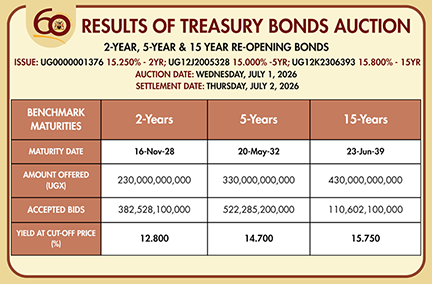
The government offered Treasury bonds worth Shs990 billion across the three maturities. Investors submitted bids exceeding Shs2 trillion, demonstrating continued appetite for government securities despite an uncertain economic environment. Treasury bonds are long-term loans made by investors to the government. In return, investors receive regular interest payments before the principal is repaid when the bond matures.
The strongest appetite in absolute terms came from the five-year bond. Against an offer of Shs330 billion, investors submitted bids worth more than Shs824 billion. The government accepted approximately Shs522.3 billion, well above the initial offer, suggesting officials were prepared to increase borrowing at that maturity while maintaining an acceptable cost of financing.
The two-year bond attracted bids worth about Shs545.5 billion against an offer of Shs230 billion. The government ultimately accepted Shs382.5 billion, again exceeding the original target.
The picture changed at the longer end of the market. The 15-year bond attracted bids worth roughly Shs655.4 billion for an offer of Shs430 billion. On paper, demand appeared robust. Yet the government accepted only Shs140.6 billion, less than one-third of what had initially been offered.
That contrast is perhaps the auction’s most significant feature.
A bond auction is not simply a measure of how much investors want to buy government debt. It is also a negotiation over price. Investors indicate the return they expect in exchange for lending their money, while the government decides whether those borrowing costs are acceptable. Rejecting bids is therefore not necessarily a sign of weak demand. Instead, it can indicate that the government is unwilling to lock itself into paying higher interest rates for many years.
The published results point to this distinction. While investor interest remained strong across all maturities, acceptance rates differed sharply, suggesting the authorities exercised greater caution when borrowing over the longer term.
The auction’s cut-off yields also illustrate how investors value different lending horizons. The two-year bond cleared at 12.8 per cent, the five-year bond at 14.7 per cent and the 15-year bond at 15.75 per cent. Higher yields on longer-dated securities generally reflect the additional compensation investors require for tying up their money for extended periods, during which inflation, interest rates and broader economic conditions can change significantly.
For investors, the results reinforce the attraction of government securities as relatively predictable investments backed by the state. For the government, however, every increase in yield translates into higher borrowing costs that must ultimately be serviced through public finances.
The auction therefore highlights a subtle but important policy objective. Rather than maximising the amount raised at every opportunity, the government appears focused on managing the long-term cost of debt. Accepting fewer bids today may reduce future interest obligations, even if it means leaving some available funding untapped.
For ordinary Ugandans, these decisions may seem remote from everyday life, but they carry broader implications. Government borrowing helps finance public expenditure, including infrastructure and other state programmes. At the same time, the cost of servicing that debt influences the fiscal resources available for other priorities. Managing borrowing costs is therefore not only a matter for financial markets but also one of long-term public finances.
The auction also reflects the continued confidence investors place in Uganda’s domestic government securities market. Demand exceeded supply across all three maturities, indicating that investors remain willing to hold government debt despite differing views on what constitutes an acceptable return.
At the same time, the varying acceptance rates reveal that strong demand alone does not determine the outcome of an auction. The government retains discretion over how much to borrow and at what cost, allowing it to balance immediate financing needs against longer-term fiscal sustainability.
The Bank of Uganda’s published results do not explain the reasoning behind individual acceptance decisions, nor do they comment on wider market conditions. What they do show is a market in which investors were willing to commit substantial capital, while the government chose to borrow selectively rather than indiscriminately. In an environment where the price of money matters as much as access to it, that distinction may be the clearest signal to emerge from the latest auction.