
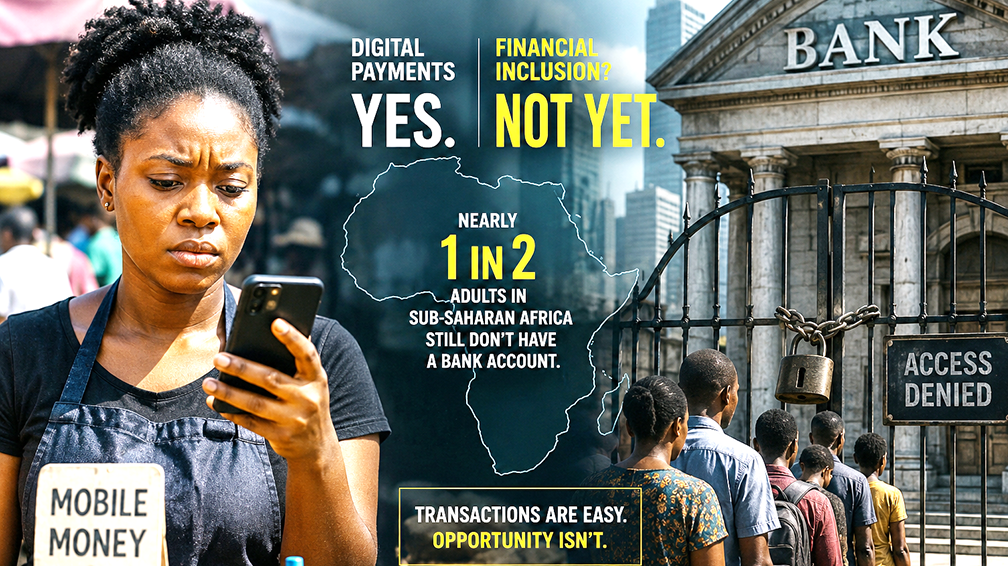
KAMPALA – What if the biggest barrier to escaping poverty isn’t the lack of money, but the inability to convince a bank you exist?
Across Africa, millions of people can pay bills, receive money and shop with a tap on their phones. Mobile money has transformed daily life, making financial transactions faster and easier than ever before. Yet behind this digital revolution lies a stubborn reality: nearly half of adults in sub-Saharan Africa still don’t have a bank account. For them, sending money is easy. Building wealth isn’t.
That contradiction is quietly shaping Africa’s economic future. A market vendor in Kampala may process dozens of digital payments every day but still fail to qualify for a small business loan. A young graduate can pay university fees electronically yet struggle to finance a postgraduate degree or start a company. A family can receive remittances from relatives overseas without ever building the financial history needed to buy a home.
Digital finance has expanded access to transactions. It hasn’t guaranteed access to opportunity.
Standard Bank’s latest Report to Society argues that Africa’s next financial revolution will not be measured by the number of smartphones in people’s pockets or mobile wallets on their screens. It will be measured by whether ordinary Africans can save, borrow, invest and build lasting financial security. That shift, the report suggests, could determine whether Africa’s young and rapidly growing population becomes the continent’s greatest economic strength, or one of its biggest missed opportunities.
The numbers illustrate both remarkable progress and stubborn inequality.
According to the report, 40 per cent of adults in sub-Saharan Africa now have a mobile money account, up sharply from 27 per cent in 2021. Smartphone ownership continues to rise across much of the continent, creating new opportunities to reach people who have traditionally been excluded from formal banking.
Yet another figure tells a very different story. Half of all adults in sub-Saharan Africa still have no bank account of any kind. The digital revolution, in other words, has not yet become a banking revolution.
That distinction matters more than it may first appear.
Mobile money has transformed how Africans send and receive cash. It has made payments faster, cheaper and more convenient, particularly where banking infrastructure has historically been weak. But paying someone through a phone does not automatically build a financial history. It does not necessarily help someone save consistently, obtain affordable credit, insure their family or buy a home.
Financial inclusion is much broader than digital payments. It means having reliable access to affordable financial services that improve people’s economic security over time.
Standard Bank describes financial health as enabling people to manage day-to-day finances, prepare for unexpected shocks, invest in their future and protect what matters most to them. That requires much more than a digital wallet. It requires trust, education, suitable products and access.
The uneven nature of financial inclusion across Africa demonstrates why the challenge cannot be solved through technology alone.
Countries such as Kenya, Mauritius, Ghana, South Africa, Namibia and Zambia have achieved relatively high banking penetration, with more than 70 per cent of adults holding bank accounts and widespread use of digital payments. Others, including Nigeria, Tanzania, Mozambique, Malawi and Zimbabwe, continue to record much lower levels of formal savings and banking participation despite growing digital activity.
Uganda occupies an interesting position within this landscape.
The report notes that formal savings rates in Uganda are among the stronger performers in the region, alongside Kenya, Ghana and Zambia. Yet, as in many African countries, significant sections of the population remain outside mainstream banking, particularly younger people, informal workers and lower-income households.
For decades, banks approached financial inclusion largely by expanding their physical footprint. More branches meant more customers. That model is becoming increasingly difficult to sustain.
Large sections of Africa remain rural. Building and maintaining branches is expensive. Customers often travel long distances only to perform transactions that could theoretically happen on a phone within seconds.
Instead, the challenge has shifted. Today’s question is not simply whether people can reach a bank. It is whether banking can reach people where they already are.
Standard Bank’s strategy reflects this changing reality. Rather than treating digital services as an alternative to traditional banking, the bank increasingly positions technology as the gateway into broader financial participation.
The report identifies several obstacles preventing millions from entering the formal financial system. Many people remain unaware of available financial products or do not understand how those services could improve their lives. Others worry about costs, hidden fees or complicated procedures.
Trust remains another major barrier. Across many African countries, fear of fraud, cybercrime and unexpected deductions discourages potential customers from opening accounts. Limited financial literacy compounds those concerns, making digital banking appear risky rather than empowering.
Infrastructure also continues to shape opportunity. Internet connectivity remains uneven. Data costs are still high in many markets. Rural communities frequently experience unreliable network coverage, while obtaining official identification documents remains difficult for some citizens. Women, young people and informal workers continue to face additional barriers to accessing credit and financial services.
These obstacles explain why technology alone cannot solve financial exclusion. The more significant challenge lies in designing products that recognise how people actually earn, spend and save.
Uganda’s FlexiPay illustrates this shift in thinking. Unlike traditional bank accounts, FlexiPay was designed to serve both banked and unbanked users. Accessible through feature phones, smartphones and web platforms, it allows customers to open accounts digitally while accessing services ranging from deposits and withdrawals to school fee payments, airtime purchases, utility payments, merchant transactions, micro-lending and interest-bearing savings.
Its importance lies less in the technology itself than in the flexibility it offers. Someone without a conventional banking relationship can begin participating in formal financial services without first navigating the traditional barriers that have historically excluded millions.
The platform’s growth suggests there is demand for that approach.
By the end of 2025, FlexiPay had issued 16,915 micro-loans worth UGX 2.7 billion, enabled customers to accumulate UGX1.3 billion in savings balances and processed more than 22,000 international remittances valued at UGX65.4 billion. Integration with Pearl Bank’s Wendi platform expanded access to more than one million users across the two digital ecosystems.
Those figures are significant because they show digital finance evolving beyond simple money transfers.
Savings products encourage longer-term financial planning. Micro-loans help small businesses manage cash flow. International remittances connect Ugandan families to relatives working abroad while reducing transaction friction.
Each additional service deepens participation in the formal economy. Technology, however, remains only part of the equation.
The report places unusual emphasis on financial education, an area often overlooked in discussions about digital transformation.
In 2025 alone, more than 402,000 people participated in Standard Bank’s financial literacy initiatives across its markets. Programmes such as the Financial Fitness Academy, Liberty’s Mind My Money and South Africa’s WalletWise seek to equip participants with practical skills in budgeting, debt management, saving, investing and fraud awareness. Uganda’s programme reached communities through partnerships including the Church of Uganda, illustrating how trusted local institutions can help bridge gaps in financial knowledge.
This reflects a broader lesson emerging across Africa. Access without understanding rarely produces lasting inclusion.
A digital wallet is only useful if people understand how to protect themselves from scams, build savings habits and use financial products confidently. Otherwise, technology risks widening inequalities between those who can navigate increasingly complex financial systems and those who cannot.
That insight may ultimately prove more important than any individual banking app.
As Standard Bank Chief Information Officer Jörg Fischer explains, the bank’s priorities include “expanding digital access in underserved communities, enhancing our digital platforms with new services, driving innovation in payments, lending, insurance and wealth management, and strengthening data analytics to support personalisation and decision-making for our clients across Africa.”
His remarks point to a future in which financial inclusion is measured not by how many people own smartphones, but by how effectively those devices help families build resilience, accumulate assets and create economic opportunity.
That future remains within reach. But the numbers also offer a sobering reminder.
Africa has made extraordinary progress in connecting people digitally. The next arguably hard task is ensuring that digital connection translates into genuine financial empowerment rather than simply faster transactions.