
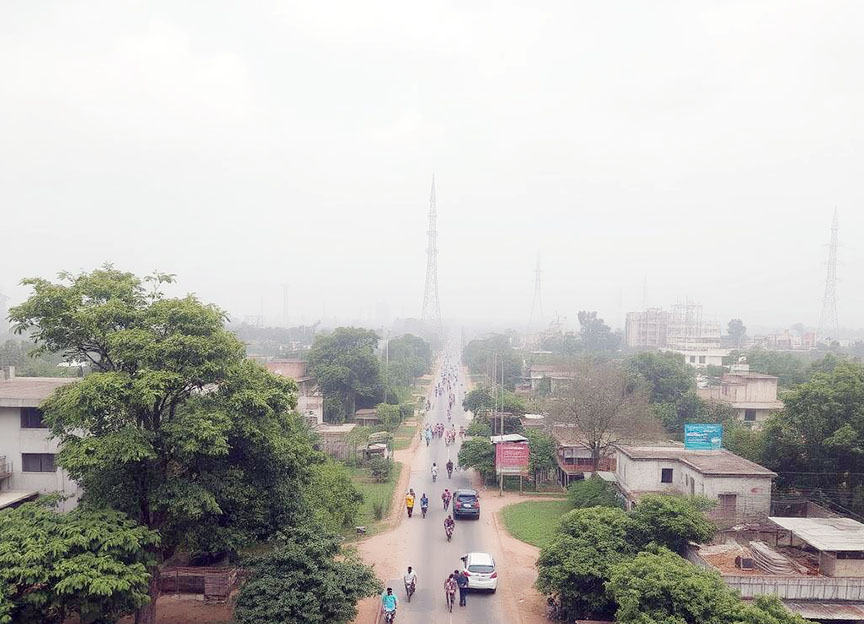
KAMPALA— It’s a silent killer, often invisible but alarmingly pervasive. Ambient air pollution—pollution from outdoor sources—claims more than 5.7 million lives every year, according to the World Bank’s 2025 report, “Accelerating Access to Clean Air for a Livable Planet.” The scale of this public health emergency is staggering, and yet it continues to unfold largely in the background of global discussions on climate and development.
Not only does air pollution rob millions of their health and years of life, it’s also a drag on prosperity. The World Bank estimates the economic damages from air pollution range between $4.5 trillion and $6.1 trillion annually, equivalent to 4.7 to 6.5 percent of global GDP. For context, that’s more than the combined GDPs of many major economies.
The Human and Economic Toll
While no region is immune, the burden falls most heavily on low- and middle-income countries, where economic development often depends on polluting industries and outdated energy systems. In South Asia, the cost of health damages from ambient air pollution exceeded 8.9 percent of GDP in 2020, without even accounting for the longer-term losses in productivity due to illness and cognitive decline.
The report reveals a grim inequality. Of the 716 million people living on less than $1.90 a day and exposed to unsafe air, most are in Sub-Saharan Africa and South Asia. Poor communities are often situated near polluting industries and high-traffic areas, while the jobs they rely on—like construction or street vending—increase their direct exposure to toxic air. These same communities also have the least access to healthcare, making the health impacts even more devastating.
The Invisible Threat: PM2.5
At the heart of this crisis is a type of air pollutant known as PM2.5—tiny particles less than 2.5 micrometers wide. That’s about 30 times smaller than the width of a human hair. Because of their size, PM2.5 particles can bypass the body’s natural defenses, enter deep into the lungs, and even reach the bloodstream. Once inside, they can trigger a range of chronic diseases, including heart disease, stroke, lung cancer, and respiratory infections.
PM2.5 is responsible for over 90 percent of all deaths related to air pollution. The World Bank emphasizes that “the amount of PM2.5 in ambient air is a consistent predictor of poor health outcomes around the world,” even impacting cognitive ability and productivity.
A Tale of Regions: Unequal Exposure
The health impacts of air pollution are unevenly distributed across the globe. In South Asia, over 1.2 billion people are exposed to PM2.5 concentrations above 35 micrograms per cubic meter (µg/m³)—a level considered hazardous. East Asia follows closely, with 660 million people in the danger zone. Sub-Saharan Africa and the Middle East are not far behind.
These numbers aren’t just statistics—they reflect shortened lives, lost educational and economic opportunities, and rising medical costs. In Sub-Saharan Africa, natural sources like desert dust mix with human activities to create a deadly air cocktail. In many areas, pollution from residential cooking, industrial emissions, and transportation compound the crisis.
The Policy Dilemma: Stated Goals vs. Bold Action
If current policies continue on their current path—what the report calls the “Stated Policies scenario”—the outlook is grim. By 2040, the number of people exposed to PM2.5 levels above 35 µg/m³ is projected to increase by 15 percent, and annual deaths from air pollution will rise to 6.2 million.
However, the report offers a path forward. An integrated policy approach—one that aligns air quality goals with climate and energy strategies—could cut global exposure to harmful PM2.5 levels in half by 2040. Such a plan would reduce annual deaths from 6.2 million to 4.1 million, and deliver global economic benefits worth up to $2.4 trillion.
From Homes to Highways: A Roadmap for Clean Air
The solutions are as varied as the sources of pollution. In many low- and middle-income countries, household energy use is a major contributor to outdoor air pollution. Millions rely on solid fuels like wood and coal for cooking and heating. Transitioning to cleaner alternatives—such as liquefied petroleum gas (LPG), biogas, or electricity—can drastically reduce PM2.5 emissions. But these changes aren’t easy. They require new infrastructure, behavioral shifts, and support for affordability.
Agriculture is another significant contributor, especially in Asia. Practices like burning crop residues, using excessive fertilizers, and operating diesel-powered equipment release harmful pollutants. Targeted investments in sustainable farming methods and cleaner technologies can make a substantial difference.
In urban areas, the transport sector is a major offender. The World Bank recommends a three-pronged strategy: “Avoid, Shift, Improve.” This means reducing the need for private travel, encouraging public transportation, and improving the emissions standards of vehicles. Cities also need better urban planning, cleaner fuels, and modern transit systems to address pollution at its core.
Cities at the Front Line
Cities are both victims and perpetrators of air pollution. Densely populated and heavily industrialized, they face some of the worst air quality conditions. But they are also uniquely positioned to lead change. Local governments can monitor pollution sources more closely, enforce regulations, and protect vulnerable populations like children, the elderly, and outdoor workers.
The report urges cities to adopt localized air quality management strategies while aligning with national goals. It also highlights the potential of nature-based solutions like urban forests, which help filter polluted air and cool overheated neighborhoods.
The Missing Link: Financing the Future
Perhaps the most significant challenge is money. Meeting global clean air targets by 2040 will require $3.2 trillion in additional investment. That might sound daunting, but when viewed as a share of global GDP, the burden actually declines—from 0.95 percent in 2020 to just 0.49 percent in 2040.
Still, financing remains a roadblock—especially in developing nations with tight budgets and competing priorities. The report calls for innovative approaches to unlock private investment. Public funds should play a catalytic role—setting standards, offering incentives, and building infrastructure—while leveraging tools like green bonds, carbon finance, and public-private partnerships.
A Breath of Fresh Possibility
The air we breathe is both a basic necessity and a powerful determinant of our health, productivity, and well-being. Yet billions inhale toxic particles every day, paying with their lives and livelihoods. The World Bank’s 2025 report lays out not just the scale of the crisis, but a clear path to change.
Time is short. If the world continues on its current path, the damage will grow—quietly but relentlessly. But if nations act boldly, embracing integrated policies and investing in proven solutions, the reward will be profound: cleaner air, longer lives, healthier economies.
In the end, clean air is not just an environmental goal. It is a matter of justice, opportunity, and survival.