

C-NEWS BUREAU CHIEF
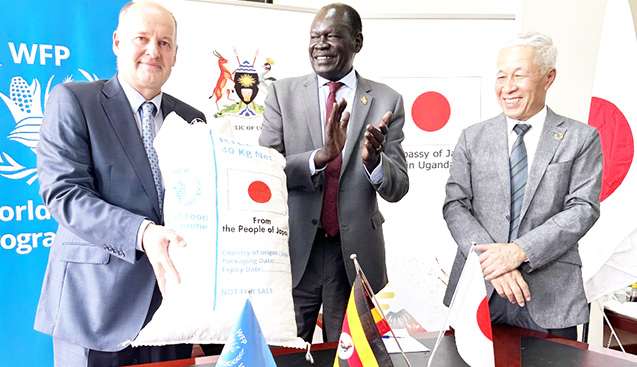
KAMPALA – In a statement released on February 22, 2024, the United Nations World Food Programme (WFP) in Uganda announced a significant donation from the Government of Japan. This contribution, comprising 2,000 metric tons of rice valued at JPY 300 million (USD 2.2 million), is earmarked to support 50,000 newly arriving refugees in Uganda in the years 2024/2025.
H.E. Mr. Fukazawa Hidemoto, the Ambassador of Japan to Uganda, explained the focus of the aid: “We are targeting new refugees in reception and transit centers because the time right after fleeing crisis is of extreme difficulty and vulnerability.” This donation aligns with Japan’s humanitarian commitment to Uganda, especially at a time when the region is grappling with an influx of refugees and multiple crises.
Uganda, which hosts 1.5 million refugees – the highest number in any African country – saw 130,000 refugees arrive last year alone. Many of these individuals are escaping conflict from South Sudan, the Democratic Republic of Congo (DRC), Somalia, and Sudan, often reaching the border on foot or by bus. Despite Uganda’s progressive refugee policy, these individuals face limited livelihood opportunities and largely depend on humanitarian assistance.
Mr. Abdirahman Meygag, WFP Uganda’s Representative, expressed gratitude towards the Japanese government for their timely support. He highlighted the importance of this aid, stating, “When refugees receive a hot meal on arrival, it is a relief after long, often difficult journeys, with no food or water for days. This marks the beginning of recovery and hope as they then settle to find ways of rebuilding their lives.”
The WFP in Uganda currently supports 1.4 million out of the 1.5 million refugees with monthly food and cash assistance. However, the growing gap between humanitarian needs and available funding has led to difficult decisions. WFP now prioritizes the most vulnerable refugees for food assistance, with very vulnerable households receiving 60 percent of regular food rations, and less vulnerable families receiving 30 percent. Households deemed not vulnerable have been weaned off food assistance and are connected to long-term livelihood opportunities. All new arrivals receive a full food ration for their first three months.
This contribution from Japan is crucial for WFP’s continued effort in Uganda, which requires USD 134 million for refugee support in 2024. The United Nations World Food Programme, as the world’s largest humanitarian organization, plays a pivotal role in saving lives in emergencies and using food assistance to foster peace, stability, and prosperity for people affected by conflict, disasters, and climate change impacts.
Top of Form
