

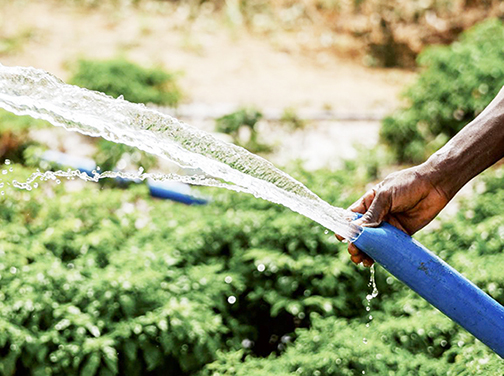
KAMPALA – For generations, the global food debate has focused on familiar ingredients: land, seeds, fertiliser, tractors, trade. But a new World Bank assessment argues that the most decisive variable may be something simpler and more fundamental.
Water.
The World Bank’s 2026 Global Water Monitoring Report, Nourish and Flourish: Water Solutions to Feed 10 Billion People on a Livable Planet, makes a startling claim. Current global water and food systems can sustainably feed only 3.4 billion people, far below today’s population of 8 billion, and dramatically below the nearly 10 billion expected by 2050.
The world, in other words, is not facing a future food crisis because it lacks calories. It is facing one because too much current production depends on ecological overshoot: depleted aquifers, damaged rivers, biodiversity loss and subsidy systems that reward waste rather than efficiency.
That reframes the challenge entirely.
The question is no longer simply how to grow more food. It is how to govern water more intelligently.
For decades, water scarcity was often described as a universal shortage. The report rejects that idea. Instead, it presents a world divided not between countries with water and countries without it, but between those that manage water productively and those that do not.
Some nations pump groundwater faster than nature can replenish it. Others possess rivers, rainfall or shallow aquifers that remain economically underused. In parts of Asia and the Middle East, over-extraction has become the central danger. In much of Sub-Saharan Africa, the opposite problem dominates underdevelopment.
This distinction matters because it overturns an old policy instinct. For years, irrigation expansion was sometimes treated with suspicion, associated with environmental stress. The report argues that in poorer regions, failing to invest in irrigation can be even more damaging, because low productivity drives hunger, land degradation, migration and vulnerability to drought.
Sometimes, using more water in the right places can reduce pressure overall.
That is because irrigation raises yields on existing farmland, reducing the need to clear forests or cultivate fragile land elsewhere. It turns water from a consumption story into an efficiency story.
The global numbers are striking.
Although irrigated land represents a relatively small share of agricultural area, it produces roughly 40 per cent of global food output. The World Bank estimates that converting viable rainfed land to sustainable irrigation could create 245 million jobs worldwide, including 218 million in Sub-Saharan Africa.
Those figures transform irrigation from a technical farming issue into something much larger: a jobs strategy, an anti-migration strategy, an industrialisation strategy and a stability strategy.
For Africa, where millions of young people enter labour markets each year, this may be the most consequential development opportunity of the next quarter-century.
Traditional factory-led industrialisation remains essential, but it is often too slow to absorb rapidly expanding workforces. Irrigation-linked agriculture can move faster. It creates farm jobs, but also work in transport, storage, packaging, food processing, repair services, finance and logistics.
The report also challenges assumptions about cost.
It estimates that global agricultural water transformation would require between US$600 billion and US$1.8 trillion between 2025 and 2050. That sounds vast until compared with the US$663 billion the world spent on agricultural support in 2023 alone.
The implication is blunt: the world already has much of the money. It simply spends it badly.
Many current subsidies reward water-intensive crops, inefficient fertiliser use, politically connected producer groups and distorted consumer pricing. Future support, the report suggests, should shift toward modernisation, efficient pumps, climate resilience, farmer credit, water data systems and ecosystem restoration.
Climate change makes the issue even more urgent.
Food crises are no longer caused only by failed harvests. They can be triggered by shipping bottlenecks, war, currency collapses, heatwaves, floods, fertiliser shortages or clusters of droughts. COVID-era disruptions and the Ukraine war exposed how fragile global supply chains can be. Nations dependent on imports without domestic resilience can find themselves vulnerable very quickly.
Yet technology alone will not solve this.
Satellites can monitor evapotranspiration. Apps can register farmers. Sensors can track groundwater. But political economy remains harder than engineering. Water reform threatens entrenched interests, subsidy beneficiaries, fragmented bureaucracies and weak institutions.
That is why the report carries a deeper geopolitical message.
Asia’s irrigation systems are mature and often stressed. Gulf states remain import-dependent. Europe faces ecological limits. Latin America has strong agricultural potential but environmental and logistical tensions. Sub-Saharan Africa, by contrast, still has room for productivity gains if water is managed wisely.
This could redefine global influence.
The next divide between nations may not be oil-rich versus oil-poor, or industrial versus non-industrial. It may be water-governed versus water-mismanaged.
For countries that understand this early, the rewards could be immense.
For those that do not, the cost may be measured in food prices, unemployment, migration and lost sovereignty.
