

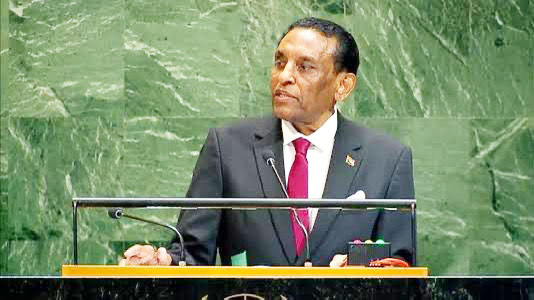
KAMPALA – When Sudan’s Prime Minister, Dr. Kamil El-Tayeb Idris, rose to address the United Nations Security Council in New York, he did so with the weight of a nation in collapse behind him, and a carefully drafted promise of what might still be saved.
Nearly two years into a war that has shattered cities, scattered families across borders, and plunged millions into hunger and exile, Sudan’s civilian transitional government has formally presented a detailed peace roadmap to the world’s most powerful diplomatic body. It is a bid not just to end the fighting, but to reclaim control of a country slipping toward permanent fracture.
“This is a decisive moment,” Dr. Idris told the Council. Sudan, he warned, stood at a crossroads: either the international community acts with urgency, or the war, and the suffering it has unleashed, will continue to spread. The conflict, he said, has exacted an “unbearable price,” tearing apart Sudan’s social fabric and extinguishing hope for an entire generation.
Sudan, he insisted, was not asking for sympathy. It was asking for partnership.
A War That Refuses to End
The government’s proposal comes against the backdrop of one of the world’s most devastating but underreported crises. Since fighting erupted between Sudan’s armed forces and the rebel militia formerly known as the Rapid Support Forces, more than 12 million people have been forced from their homes. Nearly four million have fled across borders, overwhelming neighbouring countries. Uganda alone has taken in more than 90,000 Sudanese refugees, many living in overstretched settlements with limited access to food, healthcare, and education.
Entire neighbourhoods in Khartoum and Darfur have been reduced to rubble. Hospitals have been looted, aid convoys attacked, and civilians deliberately targeted.
In its submission to the Security Council, Sudan’s government describes the war as an existential crisis, driven by a militia it accuses of grave violations of international humanitarian law. Those abuses, it argues, have triggered not only a national catastrophe but a regional security threat with global implications.
What the Peace Plan Proposes
At the heart of the initiative is a comprehensive ceasefire, to be declared under joint supervision by the United Nations, the African Union, and the League of Arab States. The ceasefire would require rebel militias to withdraw from all areas under their control, in line with the Jeddah Declaration of Principles signed in May 2023.
From there, the plan moves quickly into hard, technical terrain. Fighters would be gathered in designated camps under international oversight, registered and vetted using biometric systems to establish accountability. Disarmament would follow, with strict guarantees to prevent weapons from circulating back into the conflict.
Humanitarian access is treated as non-negotiable. The government pledged to facilitate the safe return of internally displaced people, support the voluntary repatriation of refugees, and ensure unimpeded delivery of aid to all affected areas.
“There can be no peace without protecting civilians,” Dr. Idris told the Council.
Justice, Not Amnesia
One of the initiative’s most sensitive elements is accountability. The government proposes a system that distinguishes between those responsible for war crimes, genocide, and serious human rights violations, and those who were not.
Those implicated in atrocities would face transitional justice mechanisms. Others could be eligible for reconciliation, including restoration of identity documents and participation in a future national dialogue. It is an attempt to balance justice with the political reality of reintegrating thousands of people once the guns fall silent.
Security sector reform also features prominently. Eligible individuals would be integrated into Sudan’s regular forces, while others would enter disarmament, demobilisation and reintegration programmes supported by international partners.
Economically, the plan prioritises reconstruction in Darfur, Kordofan and other war-ravaged regions, with proposals for microfinance schemes, vocational training, and job creation aimed at stabilising communities and reducing the risk of renewed violence.
From Kampala to New York
The ideas now before the Security Council did not emerge in isolation. Their roots trace back to Kampala, where Sudan’s Ambassador to Uganda, Ahmed Ibrahim Ahmed, laid out a post-war vision at a Pan-African symposium last December.
Speaking at Hotel Africana, he urged African leaders to see Sudan’s war not as a distant tragedy but as a continental test. Armed groups sustained by foreign money and weapons, he warned, risk turning Sudan into a template for proxy warfare across Africa.
“Sudan has long supported liberation movements across the continent,” the ambassador said. “Today, as Sudan endures an unprecedented war, African solidarity is more essential than ever.”
The symposium culminated in the Kampala Declaration, calling for African-led solutions, a civilian prime minister, inclusive dialogue, and the dismantling of militias that have turned neighbourhoods into battlefields.
A Test of Global Will
Whether Sudan’s initiative gains traction at the Security Council remains uncertain. Past peace efforts have faltered amid mistrust, fragmentation, and competing international interests.
But by carrying a plan forged in regional debate to the UN’s highest chamber, Sudan’s transitional government has forced a stark question onto the global stage.
As Dr. Idris put it, history will not remember the complexity of Sudan’s war. It will remember whether the world acted when it still could.
The roadmap now exists. The question is whether the international community is willing to walk it.
