

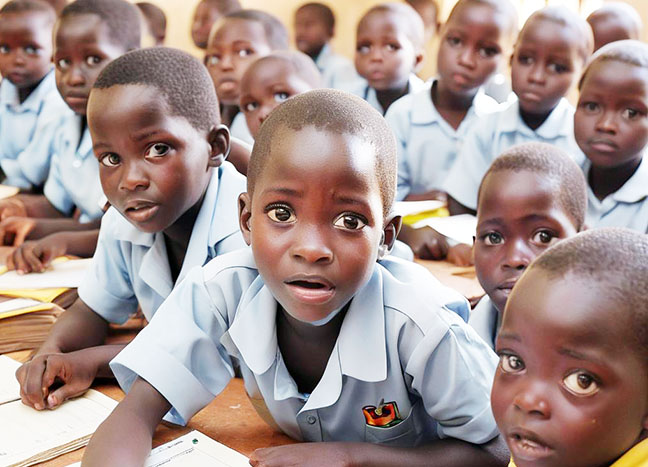
KAMPALA: Uganda’s failure to provide government-funded pre-primary education has far-reaching negative consequences, according to a report released by Human Rights Watch and the Initiative for Social and Economic Rights (ISER). The report, titled “Lay a Strong Foundation for All Children: Fees as a Discriminatory Barrier to Pre-Primary Education in Uganda,” reveals that the high fees for private preschools for children aged 3 to 5 create an insurmountable barrier for most families, particularly those in rural areas and with limited income.
The 68-page report documents how the lack of access to free pre-primary education leads to poorer performance in primary school, higher repetition and drop-out rates, and widening income inequality. Fewer than 1 in 10 Ugandan children aged 3-5 are enrolled in a registered and licensed pre-primary school, and 60 percent attend no school at all until they reach primary school.
Jo Becker, children’s rights advocacy director at Human Rights Watch, emphasized the long-term impact on children. “Early childhood learning has profound long-term benefits for children’s cognitive and social development, their health, future educational attainment, and employment,” said Becker. “Studies estimate that every shilling invested in pre-primary education in Uganda can bring up to 16 shillings in benefits.”
The report also compares Uganda’s investment in education to that of neighboring countries. Uganda devotes only 8.4 percent of its national budget to education, while Kenya and Tanzania allocate more than 18 percent. The United Nations’ 2030 Agenda for Sustainable Development calls for all governments to allocate at least 15 to 20 percent of public expenditures to education.
ISER interviewed over 100 education officials, teachers, parents, and children in various districts. Many parents shared their struggles with affording pre-primary fees. A subsistence farmer in Omoro district said, “I always struggle to find the money. For some of my children, they did not finish all the levels because I could not afford fees for every term.” An electronics businessman in Mukono district mentioned his child being sent home from nursery school due to unpaid fees.
The report highlights that the lack of free pre-primary education leads many parents to enroll their children in primary school before the standard age of 6, even though the children are often unprepared. This early enrollment creates overcrowded classes and increases repetition rates. Children who do not attend pre-primary school are twice as likely to repeat the first year of primary school.
UNICEF’s 2023 cost-benefit analysis, conducted with the Uganda Ministry of Education and Sports estimated that 90 percent of the costs of scaling up pre-primary education in Uganda could be covered through savings from reduced repetition rates and underage enrollment in primary school. More than half of the world’s countries already guarantee at least one year of free pre-primary education under their domestic laws.
Research by UNICEF, UNESCO, and the Ugandan government has found that more than half of children in the poorest 20 percent of Ugandan households never attend a day of pre-primary school. Additionally, 60 percent of early childhood development centers are located in the central and eastern regions, excluding over 80 percent of the population who are poor and live in rural areas. Expanding access to pre-primary education could reduce Primary 1 repetition rates by 50 percent and increase primary school completion rates by 12 percentage points.
The Ugandan government has acknowledged the importance of pre-primary education and set a goal for all children to have at least one year of quality pre-primary education. President Yoweri Museveni has called for the establishment of an early childhood development center at every government-funded primary school in Uganda.
“Children’s access to pre-primary schooling in Uganda should not depend on their parents’ ability to pay fees,” said Angella Kasule Nabwowe, executive director at ISER. “The government should move quickly to fulfill its promises to provide free pre-primary schooling for all children.”
