

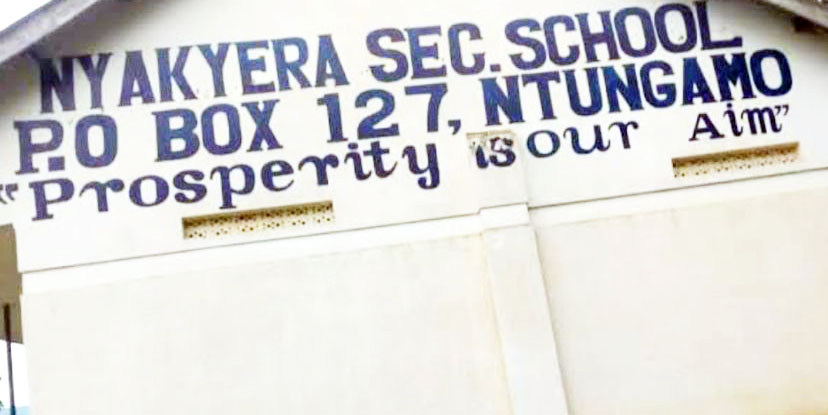
NTUNGAMO, Uganda— On the morning of April 21, 2025, what began as a regular school day at Nyakyera Secondary School nearly turned into a nightmare.
Tucked away in the hills of Kagorora Cell in Nyakyera Town Council, Ntungamo District, this quiet mixed day and boarding school became the stage for a potentially devastating act. An S.3 student, 18-year-old Hassan Niwenshaba, showed up armed with a plastic bottle of petrol, a box of matchsticks, and a razor-sharp panga. His chilling goal: to set fire to the school that had been nurturing his education and future.
But thanks to the swift instincts of school staff, the disaster was narrowly averted. Hassan was intercepted before he could act. The teachers on duty, sensing something deeply wrong, acted quickly and alerted the local police station—just in time.
The very next day, Hassan stood before the Grade One Magistrate Court in Ntungamo, facing serious charges: attempted arson and possession of dangerous equipment. Under Uganda’s Penal Code, those offenses carry steep penalties—up to 14 years in prison for attempted arson, and 7 years for possessing deadly implements like pangas.
When his case resumed on May 13, the state prosecution acknowledged his age—just 18 years—and recommended a reduced sentence. Hassan pleaded guilty to all charges. The magistrate sentenced him to 2 years and 8 months in prison, sparing him the full weight of the law but making clear the gravity of his actions.
“We’re grateful to the court,” said one school administrator, who requested anonymity. “This sentence will send a message to others. But even more importantly, we hope it helps Hassan reform and become the kind of citizen we believe he can be.”
Nyakyera SS may have narrowly avoided tragedy, but the threat of school-based arson is far from rare in Uganda. The incident joins a troubling pattern of similar attacks across western Uganda. Just last year in March, seven students at Kyamate Secondary School were arrested for setting a dormitory ablaze. That same year, a fire gutted a boys’ dormitory at Nyakabanga Secondary School in Bushenyi. In 2015, eight students from Plus Two High School were caught red-handed with five liters of petrol and matchboxes—part of a plot financed by classmates who each chipped in Shs 2,000.
These are not isolated cases. According to the 2024 Uganda Police Force Annual Crime Report, arson is a growing problem. The country recorded 1,604 arson cases last year, and school fire incidents rose by 9 percent, from 50 cases in 2023 to 55 in 2024.
Why are students turning against the very institutions that serve them? Experts point to a mix of emotional distress, peer pressure, unresolved grievances, and systemic issues in school management and mental health support. But amid the troubling trend, educators are doubling down on vigilance, care, and community engagement.
For Hassan, the sentence may serve as both punishment and a lifeline. While the magistrate’s ruling delivers justice, it also offers him a second chance—one that many in the education system hope he takes seriously.
“This could have ended very differently,” said another teacher at Nyakyera SS. “We were lucky this time. But we can’t rely on luck. Schools need support—more counselors, more engagement with students, and more training for staff on how to detect and defuse these threats early.”
Hassan’s story is not just a cautionary tale. It’s a wake-up call—for schools, parents, communities, and the education system at large. Because while the flames were stopped this time, the sparks of frustration, neglect, and fear still smolder in schools across Uganda.
As the sun rises over Nyakyera once again, it does so on a school forever changed—not by fire, but by the knowledge of how close it came.
