
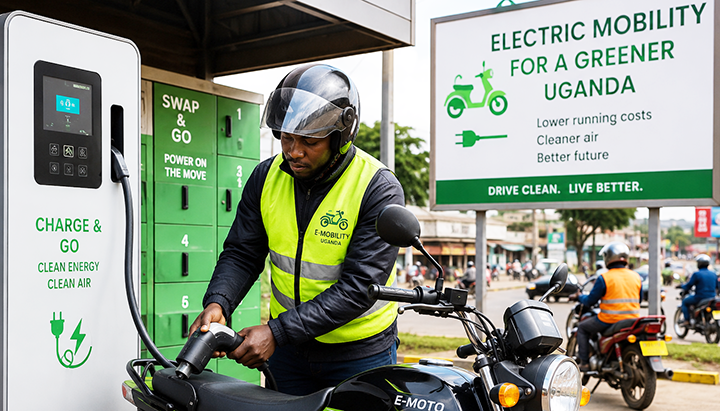
KAMPALA – For a boda boda rider, the argument for an electric motorcycle can be made at the fuel pump.
A petrol-powered bike demands money almost every day: fuel, engine oil, servicing and repairs. An electric motorcycle costs more to buy, but its owner may spend less keeping it on the road. That difference could determine whether a rider ends the week with enough money for rent, school fees and food.
New research from the Economic Policy Research Centre suggests many Ugandans are interested in electric vehicles, but enthusiasm is running ahead of affordability and infrastructure.
The December 2025 report, Is Uganda Ready for Large-Scale Adoption of Electric Mobility Vehicles? examined public awareness, consumer willingness, costs, regulation and the country’s wider ability to support electric transport. It surveyed general consumers, riders of petrol motorcycles and users of electric motorcycles, while also drawing on interviews and focus groups with industry actors. Electric Vehicles.pdf.
Electric mobility, or e-mobility, refers to transport powered partly or entirely by electricity. It includes electric motorcycles, buses and cars, as well as hybrids that combine an electric motor with a conventional engine.
The study found strong interest. About 69.2 per cent of respondents to the general consumer survey said they were highly willing to adopt an electric vehicle. Among petrol-motorcycle riders, 94.4 per cent said they would consider switching to an electric bike.
That is a striking level of openness. But willingness is not the same as purchasing power.
Nearly two-thirds of general survey respondents, 62.4 per cent, said electric vehicles were unaffordable. Only 7.5 per cent considered them affordable without assistance, while 30.1 per cent said they would need financing.
The report captures the dilemma through the words of one petrol-motorcycle rider.
“The government should establish financing options or subsidize EV prices,” the respondent said. “For example, I can’t afford to buy an EV for Shs 7 million when an ICE motorcycle costs only Shs 5 million. If taxes on EVs are reduced and the prices are made more affordable, more people will be able to buy them.”
ICE stands for internal combustion engine, the petrol- or diesel-powered technology used in most vehicles on Ugandan roads.
Another interviewee described how consumers compare electric vehicles with cheaper second-hand imports.
“Many consumers compare the costs and opt for cheaper alternatives,” the respondent said. “Instead of spending Shs 200 million on an EV, they’d rather import a fuel-powered Harrier for Shs 40–60 million and be good to go.”
The financial calculation, however, changes after purchase.
According to figures cited in the report, an average conventional vehicle uses fuel worth about $2,400 a year, compared with roughly $400 in annual electricity costs for an electric vehicle. Electric vehicles also have fewer moving parts, meaning they generally require less mechanical maintenance.
The difference is particularly important for commercial riders. Data cited from the Uganda Electric Mobility Association showed electric-motorcycle riders earning average weekly profits of Shs135,445, compared with Shs93,855 for petrol-motorcycle riders. Their weekly maintenance costs averaged Shs6,182, against Shs25,329 for conventional motorcycles.
In practical terms, the electric rider in that comparison retained about Shs41,590 more each week while spending roughly Shs19,000 less on maintenance. For someone living on daily earnings, that can be the difference between merely operating a motorcycle and building a more secure livelihood.
Electric buses show a similar pattern. The report says a diesel bus costs less to buy, about $160,000 compared with $360,000 for an electric bus, but is far more expensive to operate. Covering 100 kilometres costs an estimated Shs229,500 in diesel, against Shs38,630 in electricity for an electric bus.
The report says the total cost of owning and operating an electric bus over time is about 60 per cent of that of a diesel equivalent. The obstacle is therefore not necessarily lifetime cost, but finding the large amount of money needed at the beginning.
That explains why 55.6 per cent of consumers surveyed preferred financing or leasing rather than paying the full price upfront. Among petrol-motorcycle riders, about 77 per cent said they would be ready to purchase an electric motorcycle after a year if financial barriers were removed and suitable payment options were available.
Yet cost is only part of the problem.
More than 92 per cent of general survey respondents identified the limited number of charging stations as a barrier. Inadequate maintenance and repair services came second at 84.5 per cent, followed by the high purchase price at 82.6 per cent and unreliable electricity at 77.1 per cent.
For a driver, “charging anxiety” means worrying that the battery will run out before reaching the next charger or swapping station. The fear is greater outside Kampala and other urban centres, where charging infrastructure remains sparse.
One petrol-motorcycle rider explained the difference between familiar technology and the uncertainty surrounding electric bikes.
“With traditional motorcycles, if there’s a problem, we know how to fix it immediately,” the rider said. “But with EVs, we are unsure how to handle issues when they arise.”
That concern is not theoretical. Garage operators interviewed by the researchers said they lack trained technicians, specialised equipment and spare parts for fully electric vehicles. One operator said workshops had little reason to invest while demand remained low.
“Our skill capacity is limited to hybrids,” the garage operator said. “Fully EVs require more advanced knowledge and training.”
Uganda has nevertheless made progress. The report says the number of public fast chargers increased from 14 in 2024 to 18 in 2025. Battery-swapping stations for electric motorcycles rose much faster, from 134 to 541, spreading to more than 108 districts.
Electric-motorcycle users surveyed were largely positive: 95.2 per cent reported overall satisfaction. But nearly a third were dissatisfied with parts of the charging or repair system, showing that early users can like the technology while still struggling with the network around it.
The next stage will therefore depend on whether Uganda can make electric vehicles affordable before asking consumers to embrace them at scale. Lower operating costs are attractive, but they matter little to a driver who cannot finance the purchase, find a charger or trust that a mechanic will be available when something breaks.
The electric-vehicle debate is not simply about climate change or new technology. It is about whether cleaner transport can reduce the daily cost of moving people and goods, and whether that benefit will be available beyond the small group who can already afford to make the switch.
The author can be contacted at spinmukasa@gmail.com.