

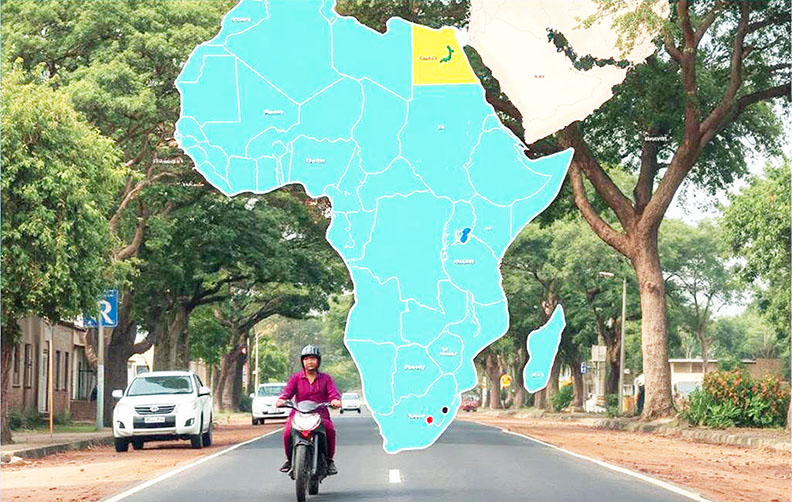
Kampala, Uganda—March 28, 2025 – As the clock ticks down to 2030, Africa stands at a critical juncture in its efforts to curb road traffic fatalities. The Africa Status Report on Road Safety 2025 offers a sobering reminder of the continent’s disproportionate burden in global road deaths, even as some countries begin to show signs of meaningful progress. With only five years remaining to meet the UN Decade of Action target of halving global road traffic deaths, the challenge for African governments, institutions, and communities is not just urgent—it is existential.
In 2021 alone, 259,601 people lost their lives in road crashes across Africa. This accounted for 24 percent of global traffic deaths, despite the continent having just 4 percent of the world’s vehicles. Behind these staggering numbers is a crisis marked by disparity. Vulnerable road users continue to bear the brunt of fatalities. Pedestrians make up 31 percent of all deaths, motorcyclists 17.5 percent, and cyclists 4.4 percent. Most of the deceased are male, with adults aged 18 to 59 disproportionately represented. Eastern and Western Africa are the hardest-hit regions, responsible for 64 percent of all road fatalities despite collectively owning only a third of the continent’s vehicles.
Beyond the human cost, Africa’s road safety crisis is exacerbated by a persistent data deficit. The report reveals that in many countries, the number of actual road fatalities is likely three times higher than official reports indicate. This gap stems from weak reporting systems that rely heavily on single data sources—typically police records—and inconsistent definitions of what constitutes a traffic fatality or injury. Only three African countries use civil registration systems to collect road crash data. Without accurate and harmonized data, designing effective road safety policies remains an uphill battle.
Institutionally, progress is uneven. While 49 countries have established Road Safety Lead Agencies, only 29 receive dedicated government funding, significantly hampering their ability to implement and enforce life-saving interventions. These agencies often lack the capacity to monitor transportation trends, coordinate multi-sectoral strategies, or track workplace-related road risks. Furthermore, just 13 countries have ratified the African Road Safety Charter, and only three have adopted all seven core UN road safety conventions. This failure to enshrine global standards into national legislation is a glaring gap that continues to weaken Africa’s road safety framework.
Yet amid the challenges, there are emerging signs of hope. The African Road Safety Observatory (ARSO), launched in 2018, is positioning itself as a regional data powerhouse. By promoting harmonized indicators and supporting regional training, ARSO is helping African countries build the analytical capacity necessary to understand and address road safety problems more effectively. Its efforts have already been recognized on the global stage, earning the Prince Michael International Road Safety Award in 2020.
Some countries are also setting new benchmarks for innovation and accountability. Morocco has developed a Collision Matrix—a data-driven tool that maps and analyzes crash patterns. This has enabled targeted safety interventions in high-risk areas, including helmet distribution campaigns, road signage improvements, and the construction of cycling lanes. The initiative has become a model for how data can drive action, even in resource-constrained settings.
Kenya, meanwhile, is pushing forward with its National Road Safety Action Plan for 2024 to 2028. This ambitious blueprint incorporates sustainable financing through a fuel levy, expanded emergency response systems, and investment in technology such as mobile breathalyzers and speed cameras. The plan also includes the development of a national trauma registry—an often-overlooked component of post-crash care that can significantly improve outcomes for accident survivors.
Still, these initiatives are the exception, not the rule. Most countries are struggling to dedicate adequate financial resources to road safety. Fewer than 20 allocate portions of fuel or toll taxes to support road safety interventions, and critical areas such as post-crash rehabilitation and research remain chronically underfunded.
The upcoming Ministerial Conference on Road Safety, set to take place in February 2025 in Marrakech, Morocco, is expected to be a turning point. As the first time Africa will host a global road safety summit, the event carries both symbolic and strategic weight. It offers a rare opportunity to secure political buy-in from African leaders, generate sustainable funding commitments, and galvanize regional coordination through platforms like ARSO. Expectations are high, and the stakes even higher.
To meet the Sustainable Development Goal of halving road deaths by 2030, Africa needs more than international applause for isolated reforms.
