
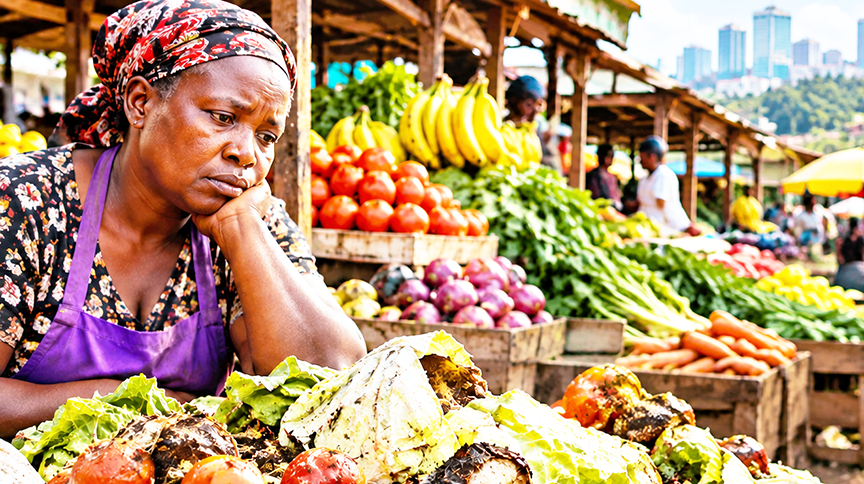
An assessment of 100 vendors in Kalerwe and Nakawa markets reveals how poor storage, oversupply and weak consumer demand are eating into traders’ incomes, prompting a search for solutions that could turn waste into wealth.
Every fruit that rots before finding a buyer represents money a market vendor cannot recover. Every basket of vegetables thrown away means a household has lost food it could have eaten.
The financial cost of food waste amounted to approximately Shs 3.78 million during a recent assessment of 100 vendors across Kalerwe and Nakawa, two of Kampala’s busiest fresh produce markets.
The findings expose a problem that extends beyond the piles of rotting produce in Kampala’s markets. Farmers invest resources in growing food, traders spend money transporting and purchasing it, yet some of that investment disappears before the food reaches consumers.
The losses were highlighted during a stakeholder meeting organized by the Uganda Healthcare Federation (UHF) under the Food Loss and Waste (FLAW) project, implemented in collaboration with the Centre for Health and Social Economic Improvement (CHASE-I) and the African Cities Research Consortium (ACRC).
The discussions explored how better market management, improved farming practices and innovative businesses could reduce waste while creating economic opportunities.
Where the money disappears
Kalerwe accounted for Shs 2,333,600, or 61.7 per cent, of the reported financial losses across the two markets.
Fruits represented the biggest loss, costing vendors Shs 1,387,600, equivalent to a reported 59.46 per cent of Kalerwe’s losses. Vegetables accounted for Shs 565,500, while tubers, such as potatoes, accounted for Shs 387,500.
At Nakawa, vendors recorded losses of Shs 1,450,900, representing 38.3 per cent of the combined losses.
Vegetables were the most affected, accounting for Shs 865,450, or 59.66 per cent. Tubers accounted for Shs 416,000, while fruits contributed Shs 169,500.
The differences suggest that reducing food waste requires understanding the particular challenges facing each market rather than imposing identical solutions.
In Kalerwe, oversupply accounted for 49.5 per cent of reported spoilage. When more produce arrives than customers can purchase, vendors struggle to sell everything before it deteriorates.
Late or limited consumer demand accounted for another 29.5 per cent, while inadequate storage contributed 14.5 per cent. Poor handling and packaging after harvesting were also identified as problems.
At Nakawa, weak consumer demand accounted for 59.41 per cent of reported spoilage, while inadequate storage contributed 16 per cent.
These findings suggest that improving storage alone may not solve the problem. Traders also need better ways of matching supplies with consumer demand.
Who takes responsibility?
Officials from Kampala Capital City Authority (KCCA) expressed concern that some vendors leave responsibility for managing waste around their stalls entirely to municipal cleaning teams.
“Vendors often just wait for KCCA to clear the mess, which frequently overstretches municipal capacity,” said Emily Namanya, KCCA’s supervisor for solid waste and environment management.
Some changes are already underway.
Johnson Tushabomwe, representing KCCA’s solid waste management team at Nakawa, said systematic sorting had begun, allowing organic waste to be separated from plastics before collection trucks depart.
Separating waste makes it easier to recover materials that would otherwise be mixed and discarded.
However, preventing food from spoiling in the first place requires action beyond the markets.
Dr Musunga David, KCCA’s deputy director for production and marketing, emphasized the need for a farm-to-plate approach.
This means examining how food is grown, harvested, handled, transported, stored and eventually sold. Improving farming and post-harvest practices can help produce remain fresh for longer, preserving its nutritional and commercial value.
Turning waste into business
Some organizations are already exploring commercial uses for discarded food.
Awori Sylivia, representing IRC, said organic market waste was being used to rear black soldier fly larvae, which provide protein-rich animal feed. Organic remnants are also being processed into energy briquettes.
Other proposals include redistributing unsold food that remains safe for consumption to vulnerable communities, processing fruits into juice, making pineapple-based biscuits and exploring beverages derived from avocado seeds.
These initiatives form part of what is known as the circular economy: finding productive uses for materials that would otherwise be discarded.
But businesses seeking to use market waste face a practical obstacle. Unpredictable collection makes it difficult to obtain reliable supplies of separated organic material.
Stakeholders appealed to UHF and KCCA to establish communication desks within major markets, with designated personnel coordinating predictable collection directly from vendors’ stalls.
The meeting also identified resource mobilization, greater flexibility in KCCA policies and collection arrangements that encourage vendors to recognize the economic value of organic waste as priorities.
The challenge now is turning these proposals into workable arrangements that benefit traders, consumers and waste-processing businesses.
Cleaner markets would be a welcome outcome. But preventing unnecessary spoilage could deliver something more valuable: protecting vendors’ earnings and keeping edible food available for consumption.
Kampala’s opportunity lies not merely in finding profitable uses for rotten food, but in ensuring that less food rots in the first place.