
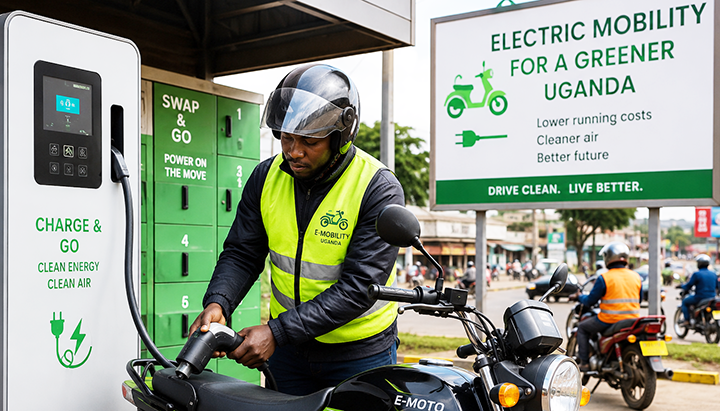
KAMPALA – Uganda’s electric-vehicle transition is caught in a familiar trap.
Investors are reluctant to build more charging stations because there are still too few electric vehicles. Consumers hesitate to buy electric vehicles because there are too few places to charge them.
New research from the Economic Policy Research Centre (EPRC) calls this the classic “chicken-or-egg” problem. It lies at the centre of Uganda’s attempt to build an electric-mobility industry: demand depends on infrastructure, but infrastructure investment depends on demand.
Measured against other African countries, Uganda is neither starting from scratch nor ready for a mass transition.
The researchers gave the country an electric-vehicle readiness score of 0.67 on a scale of zero to one. That places Uganda above the African average of 0.58, but behind Rwanda at 0.74 and Kenya and Ethiopia, both at 0.70.
A readiness score combines the conditions needed to support electric vehicles, including infrastructure, energy, policy, market demand and industrial capacity. Uganda’s position suggests that it has many of the necessary building blocks but has not yet connected them into a reliable system.
The country has several advantages.
More than 90 per cent of electricity supplied to Uganda’s grid comes from renewable sources, according to the report. That means electric transport could reduce emissions more effectively than in countries where electricity is generated mainly from coal or oil.
Uganda also has minerals including cobalt, lithium and graphite, which are important in battery production. Its youthful population and large boda boda sector provide a ready market for electric motorcycles, while local manufacturing ambitions create the possibility of jobs in assembly, battery systems, charging, repair and software.
The economic case extends beyond motorists.
Uganda imports all the petroleum products used in the country, according to its Energy Transition Plan cited in the study. Fuel imports per million people rose from about 145,000 barrels in 2000 to nearly 320,000 barrels in 2021.
Every litre of petrol replaced by locally generated electricity could therefore reduce pressure on foreign exchange. The report says electric motorcycles cut petrol consumption by more than three million litres in 2024, saving nearly $3.9 million.
Cleaner transport also carries a public-health argument. Road transport contributes about 10 per cent of Uganda’s greenhouse-gas emissions, while the country’s ageing vehicle fleet worsens urban air pollution. The report cites an estimate of almost 30,000 air-pollution-related deaths in Uganda annually.
But none of these potential gains is automatic.
Uganda has already adopted a National E-Mobility Strategy and included electric transport in the Fourth National Development Plan. Policies call for charging stations, stronger electricity infrastructure, local manufacturing, financing and cleaner transport systems.
The report’s central criticism is that policy ambition has moved faster than implementation.
Regulatory responsibilities remain fragmented across agencies. Charging guidelines and other electric-vehicle rules have not all been finalised. Investors face delays when seeking new transformers or stronger grid connections, while inconsistent tax policy has created uncertainty.
The study points specifically to the reinstatement of a 25 per cent import duty on electric vehicles and duties on knocked-down kit vehicle parts imported for local assembly. These measures can raise consumer prices and production costs, potentially working against Uganda’s stated goal of expanding local electric-vehicle manufacturing.
The market is also heavily dependent on imported parts. That exposes manufacturers and users to exchange-rate movements, global supply disruptions and delays in obtaining replacements.
There is a further risk for mechanics and traders whose livelihoods depend on conventional vehicles. Electric vehicles require fewer oil changes and fewer mechanical parts. That could reduce business for some existing garages, fuel-related enterprises and spare-parts dealers unless workers are retrained.
The report does not argue that Uganda should abandon the transition because some jobs may disappear. Instead, it calls for preparation. Mechanics, electricians, emergency responders and manufacturing technicians need new skills before the market changes around them.
Battery disposal is another unresolved issue. An electric vehicle may produce no exhaust fumes on the road, but its environmental benefit can be undermined if worn-out batteries are dumped, mishandled or recycled unsafely.
Uganda has rules governing electronic waste, yet the researchers say enforcement and recycling capacity remain weak. They recommend a regulated system in which producers share responsibility for collecting, reusing and recycling batteries after their useful life.
The report also raises a warning about second-hand electric vehicles.
Uganda currently allows the importation of used vehicles up to 15 years from their first registration, but battery condition can deteriorate with age. A cheap used electric car may become expensive if the buyer soon has to replace its battery.
To protect consumers, the researchers recommend limiting imported second-hand electric vehicles to those no more than five years old and requiring battery testing before shipment. That would make hidden battery damage easier to detect before a vehicle reaches the buyer.
The wider policy package is extensive. The researchers want government to produce a national charging master plan, simplify grid connections, support private investment in underserved areas and include chargers in new commercial buildings, parking spaces and urban plans.
They also call for low-interest financing and leasing, public awareness campaigns in local languages, technician certification, electric-vehicle courses in vocational institutions, and faster passage of electric-vehicle legislation and charging guidelines.
The challenge is coordination. The ministries responsible for energy, transport, finance, education, local government and urban planning all have a role, as do regulators, standards bodies, banks, manufacturers and electricity distributors.
Without clear leadership, each institution can complete its own assignment while the overall system remains incomplete.
What happens next will determine whether electric mobility becomes an affordable national transport option or stays concentrated in a few urban fleets and pilot projects.
Uganda has electricity, consumer interest and a growing network of electric motorcycles. What it lacks is a fully connected market in which vehicles, finance, charging, repairs, standards and battery disposal develop together.
The transition will not be measured by how many strategies are launched or electric vehicles displayed. It will be measured by whether a rider in Jinja, a taxi operator in Mbarara or a household outside Kampala can buy an electric vehicle, charge it reliably, repair it locally and save money over time.
The author can be contacted at spinmukasa@gmail.com.