
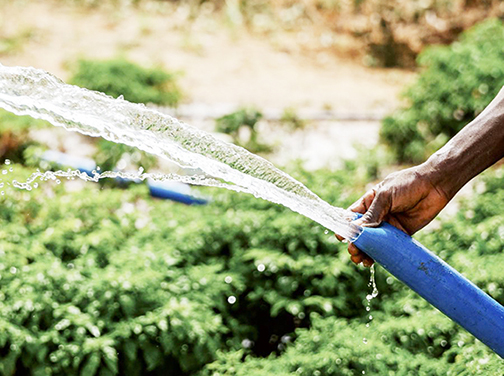
KAMPALA — Uganda is often described through its geography: the source of the Nile, the shores of Lake Victoria, fertile soils, generous rainfall and multiple agro-ecological zones. Yet for all that natural abundance, much of its agriculture still behaves as if the country were water-poor.
Farmers wait anxiously for rain. Harvests rise and fall with weather patterns. Food prices spike after dry spells. Export potential remains underused.
According to the World Bank’s 2026 Global Water Monitoring Report, that mismatch may represent one of Uganda’s biggest economic opportunities. While water-stressed countries spend fortunes coping with scarcity, Uganda’s challenge is different: organising and using the water it already has.
If it succeeds, the country could become one of East Africa’s most important agricultural powerhouses.
The World Bank identifies much of Sub-Saharan Africa as suffering not from absolute water shortage, but from weak storage, limited irrigation, financing gaps and governance failures. Uganda fits that pattern. It has Lake Victoria, Nile basin systems, seasonal rainfall, groundwater opportunities, strong domestic demand and export access into Kenya, South Sudan, the Democratic Republic of Congo and Rwanda. Yet productivity remains constrained by dependence on rainfall and low irrigation penetration.
That means Uganda’s future may hinge less on discovering new resources than on mobilising existing ones.
The first opportunity is grain stability.
East Africa regularly experiences maize shortages, price swings and cross-border supply shocks. Uganda already exports grain informally and formally into neighbouring states. With scaled irrigation, multiple cropping seasons and better storage, the country could move from opportunistic exporter to dependable regional stabiliser.
That matters politically as much as economically. Food exporters gain influence. They cushion neighbours during drought and earn foreign exchange during scarcity.
The second opportunity is horticulture.
Global demand for fresh produce, flowers, fruits and vegetables continues to grow, particularly in Gulf and European markets. Irrigation is essential because horticulture depends on predictable quality, timing and consistency. Rainfed systems struggle to guarantee all three.
Uganda’s climate and altitude offer advantages for high-value crops. Reliable irrigation could turn those natural strengths into export earnings, jobs for young workers and stronger air cargo demand through Entebbe.
The third opportunity is livestock feed.
As regional incomes rise, demand for meat, dairy and poultry tends to grow. That increases demand for feed maize, hay, silage and protein crops. Uganda could use irrigated farming to become a supplier of feed inputs to domestic and regional livestock industries.
This would create a second-order economic effect: lower feed costs can strengthen dairy, poultry and beef competitiveness.
The fourth opportunity is agro-processing.
Factories cannot run efficiently on erratic raw material supply. Millers, juice processors, dairy plants and exporters need steady throughput. Irrigation smooths seasonal volatility, giving processors confidence to invest.
That means water infrastructure can unlock industrial investment far beyond farming itself.
The fifth opportunity is climate-smart leadership.
As weather shocks intensify, countries that build resilient agriculture early will gain a strategic advantage. Solar pumps, micro-irrigation, efficient water-user associations, basin monitoring and protected wetlands could position Uganda as a model for productive but environmentally smarter growth.
The report specifically cites Uganda’s Micro-Scale Irrigation Program as a positive example of digital modernisation through the IrriTrack app, used to register farmers, monitor installations, train field staff and improve accountability.
That is important because it suggests Uganda is already testing a newer African model.
Not giant canals alone. Not mega-dams alone. But smallholder irrigation, solar pumping, mobile finance, digital onboarding and blended public-private delivery systems.
This model may scale faster and cost less than twentieth-century state-led irrigation schemes.
Still, the biggest barriers are likely institutional.
Uganda’s challenge is not simply engineering canals or importing pumps. It is coordinating ministries, districts, water agencies, financiers, agriculture officers and local governments. It is resolving land disputes. It is ensuring subsidies reach productive assets rather than leak into patronage networks.
The World Bank notes that global transformation needs US$600 billion to US$1.8 trillion between 2025 and 2050, yet agricultural support spending reached US$663 billion in 2023 alone. The lesson for Uganda is clear: limited fiscal space must be used carefully.
Broad subsidies are expensive and often wasteful. Smarter bets would include small-scale irrigation finance, rural feeder roads, solar pump affordability, crop insurance, basin data systems and export corridors for high-value produce.
Uganda’s population is young, and job creation pressure is intense. Irrigated value chains can absorb labour more quickly than many formal sectors: mechanics repairing pumps, transporters moving produce, packhouses grading exports, traders supplying inputs, technicians maintaining cold chains.
Water, in this sense, becomes labour policy.
The country does not need an oil-style miracle to transform agriculture. It already has lakes, rivers, rainfall and regional markets. What it needs is organisation.
If Uganda aligns water policy with jobs, exports and industry, it could feed itself more reliably, steady neighbouring markets and become one of Africa’s most credible examples of climate-smart agricultural growth.
A lake-rich nation behaving like a water-poor one would be a wasted inheritance.
A lake-rich nation that learns to govern abundance could become something else entirely: prosperous.