
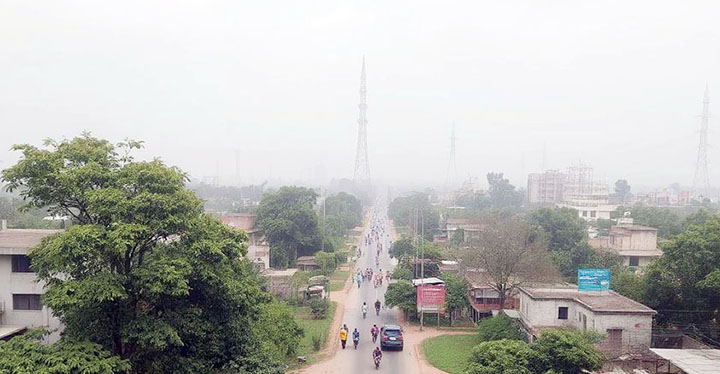
KAMPALA – By the time the sun rises over Kampala, the damage has already begun.
It drifts through taxi parks and construction sites, settles into classrooms and hospital wards, and lingers above neighborhoods where charcoal smoke curls into the morning sky. You cannot see most of it. You rarely think about it. But according to the World Bank’s Reboot Development: The Economics of a Livable Planet, the air we breathe is quietly draining trillions from the global economy, and reshaping the future of countries like Uganda.
For decades, development was measured in roads paved, factories built, and GDP gained. Nature was treated as background, scenic, abundant, forgiving. Now the bill has arrived. Air pollution alone costs the global economy roughly $8 trillion a year. Nearly 80 percent of people in low-income countries face a triple burden of degraded land, unsafe air, and water stress. Humanity has crossed six of nine planetary boundaries.
The report’s message is unsettling but clear: nature is not collateral damage of growth. It is the foundation of growth. And that foundation is cracking.
The $8 Trillion Drag in the Air
The numbers land hard. Poor air quality contributes to 5.7 million global deaths annually. Inadequate water, sanitation, and hygiene account for another 1.4 million deaths each year. Air pollution alone costs the global economy roughly $8 trillion annually, about 6.1 percent of global GDP.
These are not distant abstractions. Pollution erodes productivity in quieter ways too: diminished cognitive performance, poorer educational outcomes, and rising absenteeism. Workers fall sick. Students struggle to concentrate. Economies lose momentum.
For Uganda, where urbanization is accelerating, and vehicle imports continue to climb, the warning resonates. Kampala’s air quality frequently exceeds recommended limits. Across East Africa, informal settlements still lack adequate sanitation. The Bank’s argument is clear: the health bill shows up later as a growth problem.
Crucially, the report rejects the old development narrative that pollution is an unavoidable stage of industrialization. China’s recent experience, growing its economy while cutting fine particulate pollution, demonstrates that policy design matters. The implication for African policymakers is sobering but empowering: environmental reform is not anti-growth. Done well, it is pro-growth.
The report dismantles another long-held assumption, that environmental damage fades as countries get richer. Instead, it finds degradation deeply entangled with poverty.
Nearly 80 percent of people in low-income countries are exposed simultaneously to land degradation, unsafe air pollution, and water stress. Globally, 90 percent of the population lives in areas where at least one of these foundational resources is degraded.
Poor communities are 75 percent more likely to live on degraded land. They are also less likely to have piped water, sanitation, or reliable electricity. The result is a compounding vulnerability: weaker health, lower productivity, fewer opportunities.
In rural Uganda, where agriculture remains the backbone of livelihoods, soil degradation and erratic rainfall are already reshaping harvests. The Bank’s framing turns what is often labeled an “environmental issue” into something more structural. If land weakens, labor weakens. If water falters, industry falters. Environmental deterioration becomes a headwind against growth itself.
A Planet Pushed Beyond Its Limits
The scale of ecological transformation is staggering. Before the Industrial Revolution, humans and livestock made up about half of all mammalian biomass. Today, they account for 95 percent. Wild mammals occupy just 5 percent.
More troubling, humanity has crossed six of nine planetary boundaries, the ecological thresholds that regulate climate stability, biodiversity, freshwater systems, and nutrient cycles. These boundaries are not academic lines on a chart. When crossed, they translate into crop losses, hydropower disruptions, disease outbreaks, and infrastructure damage.
For countries dependent on rain-fed agriculture or hydropower, Uganda included, those risks are immediate. Once certain tipping points are breached, recovery may not occur within human timescales.
For business leaders, the message is unmistakable: environmental risk is systemic risk.
Forests as Rainmakers, Not Just Carbon Sinks
One of the report’s most compelling insights is that nature provides economic services we rarely price correctly.
Take forests. They are not just carbon storage units; they are engines of rainfall. Nearly half of global precipitation originates from land-based moisture recycled through vegetation.
Deforestation in the Amazon, Congo Basin, and Southeast Asia has already reduced rainfall patterns, costing the global economy more than $15 billion annually in lost growth. Loss of soil moisture, what scientists call “green water,” could cost around $379 billion, roughly 8 percent of global agricultural GDP.
Natural forests provide more than twice the drought protection of plantations. That distinction matters for countries like Uganda, where debates over commercial tree planting versus conserving intact forests are ongoing. Replace complexity with monoculture, and resilience weakens.
The Nitrogen Trap
The Green Revolution once symbolized agricultural triumph. Today, fertilizer tells a more complicated story.
More than half of nitrogen applied to fields globally is wasted, seeping into water systems or evaporating into the air. Nearly half of the world’s calories are produced in regions where adding more nitrogen actually reduces productivity.
The annual global cost of nitrogen pollution could reach $3.4 trillion, driven by health damage, fisheries collapse, and soil degradation.
In Uganda, where fertilizer use remains relatively low compared to global averages, the warning is preventative rather than corrective. The Bank’s broader lesson is that productivity gains detached from ecological limits can backfire.
Cities at the Crossroads
By 2050, nearly two-thirds of humanity will live in cities. Urban areas drive innovation and productivity, but they also intensify heat stress, water scarcity, and deforestation.
Urban expansion has displaced cropland, pushing agriculture into forested areas equivalent to nearly three times the size of England.
Yet cities also hold promise. In arid environments, urban greening can reduce extreme heat by up to 7.6°C. In Kampala, where temperatures climb and green spaces shrink, that figure feels less theoretical.
Urban design, the report suggests, is macroeconomic policy.
The Bank organizes environmental pressure around three forces: scale (bigger economies use more resources), composition (what sectors dominate), and efficiency (how resources are used per unit of output).
Efficiency improvements have offset 59 percent of scale-driven increases in air pollution. But composition shifts—moving away from pollution-intensive sectors—have played only a minor role so far.
The waste is striking:
- 30 percent of food is lost or wasted.
- Over 50 percent of nitrogen fertilizer fails to reach crops.
- Only 36 percent of primary energy becomes useful work or heat.
- Roughly 30 percent of water supply globally is lost before reaching consumers.
Efficiency can buy time. But eventually, economies must produce different things—shifting away from fossil fuels, nitrogen-intensive agriculture, and linear manufacturing toward circular systems.
For African economies still industrializing, this creates a narrow but powerful window: leapfrog where possible, avoid locking into high-pollution pathways.
The Green Minerals Dilemma
The transition to renewable energy depends on lithium, cobalt, nickel, and rare earths. Yet extraction often overlaps with fragile ecosystems and weak governance.
Deforestation rates are higher near transition mineral sites than at conventional mines, particularly where governance is fragile.
The report calls for transparent supply chains and stronger safeguards to avoid repeating the “resource curse.” For mineral-rich African nations, the green transition could either reinforce old extraction patterns—or build new value chains with stronger oversight.
Jobs, Growth—and Inclusion
Environmental quality shapes labor markets. Globally, 3.2 billion people depend on food systems; 61.8 million work in fisheries.
Cleaner sectors can generate more jobs per dollar invested than pollution-intensive industries. Forestry creates more than 38 jobs per $1 million invested—far exceeding many high-emission sectors. These sectors also tend to be more gender-balanced.
The green transition, then, is not only about emissions. It is about employment structures and inclusion.
The Bank’s conclusion is sobering but not fatalistic. The wealth of nations ultimately rests on natural capital. Degrade it, and decades of development gains unravel.
But the report is not a call to retreat from growth. It is a call to redefine it.
Investing in nature, the World Bank argues, is not an environmental luxury. It is smart economic policy. Cleaner air protects productivity. Healthy forests stabilize rainfall. Efficient fertilizer use prevents trillion-dollar losses. Resilient cities sustain innovation.
In Kampala’s traffic haze, the costs can feel invisible. But the balance sheet is clear. Nature is no longer a backdrop to development. It is the foundation.
And the choice ahead—for Uganda, for Africa, for the world—is whether to keep drawing down that capital, or to treat it as the most valuable asset we have.