
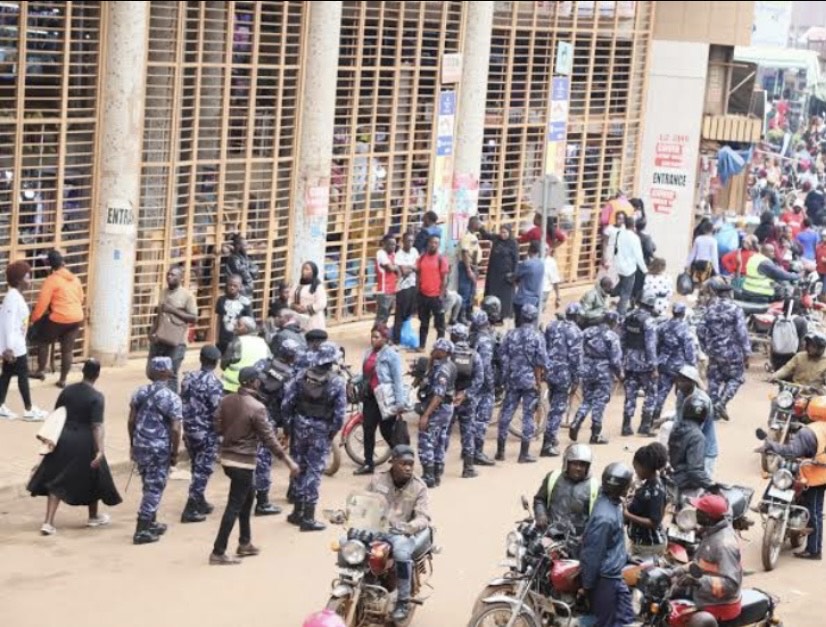
KAMPALA — On a Tuesday morning, Kampala’s downtown streets should have been alive with the usual chorus of loud bargaining, footsteps, and the hum of generators; silence settled instead. Nabugabo Road, normally one of the capital’s busiest commercial arteries, looked abandoned as shutters stayed down and arcades darkened. For the city’s traders, it was not business as usual but a collective act of defiance.
The strike, led by the Kampala City Traders Association (KACITA), is aimed squarely at the Uganda Revenue Authority (URA). Traders accuse the tax body of imposing crippling levies on imports, delaying clearance of goods at border points, and tilting the playing field in favor of foreign, particularly Chinese retailers, whom they claim enjoy tax exemptions.
“This closure has been triggered by the taxes on textiles and garments, charged by weight,” said Hajji Issa Sekitto, KACITA’s acting chairperson. “Despite explaining the issue to Parliament, the Cabinet, and even the President, nothing has been done to address it.”
Many of the grievances come down to survival. Traders argue that excessive taxes and customs duties are pushing them into debt, eroding profits, and threatening their livelihoods.
Lillian Akim, a small business owner, said URA’s policies had left her buried in loans. “These unfair taxes have left us with several debts, making the cost of living unbearable,” she said.
Others voiced the same frustration. Alaba Nabimanya, who runs a shop in Kisa kya Maria arcade, said he operates with constant losses. “We are working with deficit budgets. There are no profits anymore,” he lamented.
Police Intervention
As the strike grew in momentum, anti-riot police stormed the city center, arresting several traders accused of blowing whistles and urging others to close shop. The heavy-handed crackdown only inflamed tensions. By mid-morning, Nabugabo resembled a ghost town, its arcades firmly shut.
Not everyone joined, however. In Kikuubo, some businesses remained open, and street vendors seized the chance to make brisk sales in the absence of competition. The uneven response exposed cracks in trader solidarity.
Sekitto himself blamed the divisions on weak leadership within the trade movement. “We’re going through tough times, yet many refuse to acknowledge it. Instead of uniting traders, some leaders are working to divide and break them apart,” he said.
A Split Across the Country
While the strike immobilized Kampala’s commercial hub, it failed to ripple across the country. In Mbarara City, business carried on as usual.
Simon Mwijuka Sezi, chairperson of the Mbarara City Traders Association (MBACITA), admitted confusion over the protest. “The arrangement was unclear, and I was not officially informed. I only saw the announcement on social media,” he said.
The disconnect highlights a broader problem: while frustrations with taxation are widespread, organizing a unified nationwide protest has proven elusive.
Beyond a One-Day Strike
The traders’ action is more than a temporary disruption; it points to deeper cracks in Uganda’s trade and taxation system. Import duties, high rental fees, and competition from large foreign retailers have left small-scale shop owners feeling squeezed from every side.
The shuttered arcades of Nabugabo tell one story—that of anger, debt, and paralysis. But the street vendors selling to the crowds outside tell another: of resilience, improvisation, and the struggle to survive in an unforgiving economy.
For now, the strike has drawn national attention to the plight of Uganda’s traders. Whether it prompts meaningful reforms, lower duties, fairer tax collection, or a review of foreign retail practices, remains uncertain. What is clear is that the silence in Kampala’s shopping arcades was not just about taxes; it was about dignity, survival, and demands to be heard.