
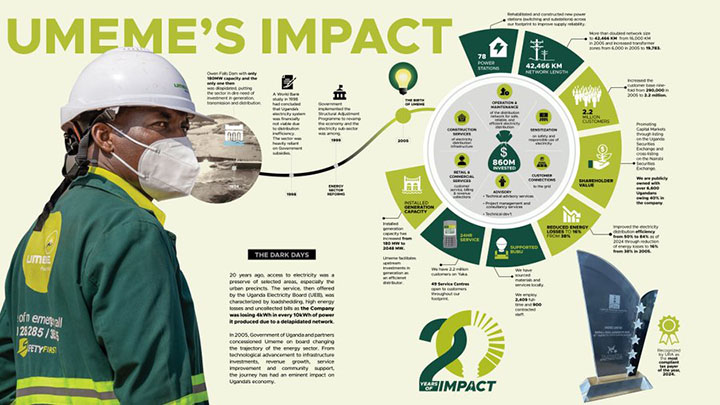
KAMPALA, UGANDA – For many Ugandan businesses, the promise of economic recovery in 2025 is colliding with a harsh reality: unstable power. While private sector confidence ticked upward in the second quarter, a new report warns that the country’s power transition—especially the April 1 handover from Umeme to Uganda Electricity Distribution Company Limited (UEDCL)—has delivered more disruption than reliability, eroding productivity and endangering industrial growth.
Released by the Economic Policy Research Centre (EPRC), Uganda’s Business Climate Index (UBCI) for Q2 shows a modest rise of 3.7 points, reaching 92.5. Yet that figure still lingers below the neutral 100 threshold, a symbolic reminder that despite cautious optimism, businesses remain in survival mode. And according to the report’s authors, power instability is fast becoming a defining challenge.
“We’ve had to run generators more often to keep production on track, which drives up our costs,” a Kampala-based manufacturer told EPRC. “Since the change in the power company, outages have become more frequent, and it’s hurting productivity.”
The report paints a mixed picture: stronger sales during the Easter season and school term reporting briefly lifted business activity, particularly in the services sector. But for energy-reliant industries, especially manufacturing—blackouts, voltage swings, and rising electricity costs have tightened the noose.
Power Struggles That Ripple Through Industry
The handover from Umeme to UEDCL was meant to mark a new chapter in Uganda’s energy management. Instead, nearly half of manufacturers (49.8%) report worsening disruptions. Overall, 42 percent of surveyed businesses said the transition negatively affected their operations, with 74 percent citing more frequent outages and 10 percent pointing to unstable voltage.
The impact is not merely logistical. With energy-intensive sectors turning to diesel generators to maintain operations, the cost of doing business is climbing—undermining profit margins and long-term competitiveness. The EPRC warns that unless these gaps are swiftly addressed, the consequences could be far-reaching.
“Reliable infrastructure is the backbone of industrial development,” said Rehema Kahunde, Research Analyst at EPRC. “Increased reliance on costly generators threatens profitability and risks stalling Uganda’s industrial ambitions.”
Gains in Services, Slippage in Manufacturing
Sector by sector, the Business Climate Index reveals widening disparities.
Services posted a 2.4-point gain, rising to 94.7, bolstered by strong performances in education, banking, warehousing, and storage—especially among large firms. The sector’s resilience, researchers note, stems from its ability to pivot quickly in response to seasonal demand.
But that same agility isn’t available to farmers or factory owners. Agriculture dipped slightly, from 99.3 to 98.3, dragged down by weakened agribusiness activity and tumbling global coffee prices. Manufacturing fared worse, falling from 81.6 to 79.9, its lowest point in over a year.
Manufacturers cited a cocktail of woes: erratic power, high input costs, shrinking selling prices, and persistent shortages of skilled labor.
“Manufacturing’s ongoing struggles reflect deep structural issues,” Kahunde explained. “These aren’t short-term fluctuations. They point to systemic bottlenecks that need urgent attention.”
Tax Burdens and the Informal Economy
Beyond electricity, the EPRC report identifies other stubborn hurdles: multiple taxation, stiff competition from informal businesses, and macroeconomic volatility—high interest rates, inflation, and weak consumer demand.
These challenges are unevenly distributed. In northern Uganda, poor transport infrastructure and limited access to finance top the list. But nationwide, one problem stands out: taxes.
“Tax-related challenges seem to crop up every quarter,” said Kahunde. “That underscores the urgent need to simplify the tax code and provide incentives for formalization, especially for small and medium enterprises.”
Looking Ahead: A Tenuous Optimism for Q3
Despite the challenges, businesses remain hopeful. Projections for the July–September period suggest a BCI increase to 100.3—crossing into neutral territory for the first time this year. Driving that optimism: expected political spending ahead of the 2026 elections, lower input costs, and seasonal agricultural surpluses.
Agriculture is forecast to hit a BCI of 109, while services may edge past neutral to 101. Manufacturing is expected to rebound slightly to 82, though still well below ideal levels.
“The anticipated uptick in activity—from elections to harvests—could help lift confidence back to neutral,” Kahunde said. “But whether that momentum holds will depend on addressing structural vulnerabilities.”
Policy Levers: Fixing the Foundations
To sustain optimism, the EPRC has laid out a series of policy recommendations, starting with power infrastructure. It calls for targeted investment in electricity distribution, anti-vandalism campaigns, and stricter enforcement against theft and sabotage of energy infrastructure.
These are not just technical fixes; they are essential for rebuilding business trust.
In its final analysis, the EPRC describes Uganda’s private sector as standing at a crossroads. Growth is within reach, but fragile. One bad quarter—another round of power failures or tax shocks—could reverse the gains.
“This isn’t just about statistics,” said one Kampala entrepreneur. “It’s about whether we can keep the lights on long enough to keep building.”