
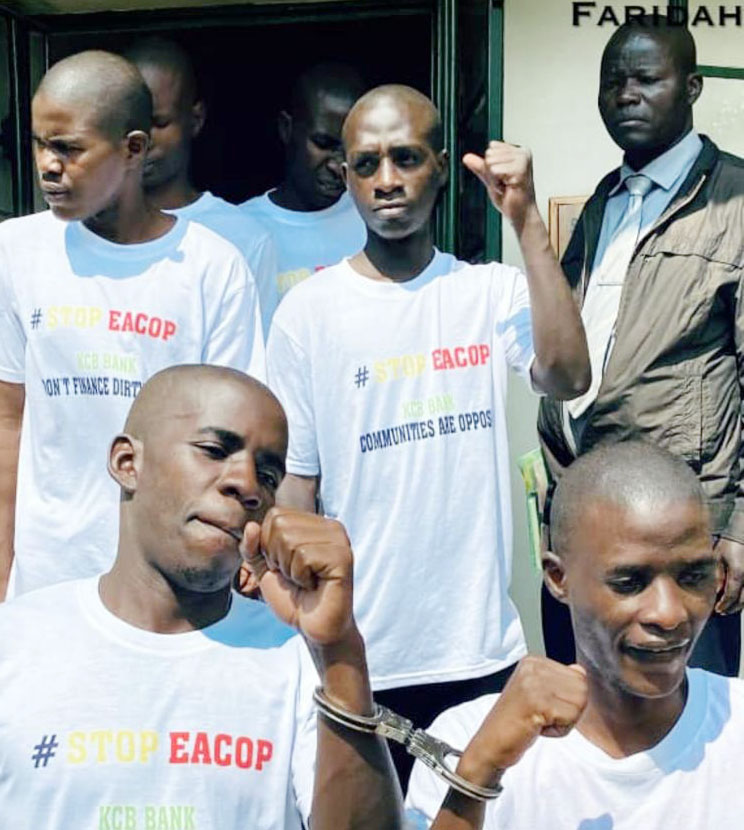
KAMPALA, Uganda— On Tuesday, July 22, outside the courthouse in Kampala, tearful reunions unfolded as 11 environmental defenders emerged into the sunlight—free for the first time in nearly three months. Among them were teacher Bob Barigye and the only woman arrested, Nalusiba Phionah. They had been imprisoned at Luzira Maximum Security Prison for peacefully protesting one of East Africa’s most controversial energy projects: the East African Crude Oil Pipeline (EACOP).
Their release, granted on July 17 after several denied applications, came with a bail of Shs 200,000 each, roughly $53, but the emotional cost, their families say, has been immeasurable. They were released officially on Tuesday, July 22, after all the families mobilized the bail cash.
A Protest, a Petition, and a Prison Sentence
The story began on April 23, 2025, with a peaceful demonstration outside Kenya Commercial Bank (KCB) headquarters in Kampala. The activists had gathered to submit a petition urging the bank to withdraw its financing from EACOP, a multi-billion-dollar oil pipeline set to cut through protected ecosystems and communities from Uganda’s Lake Albert to the Tanzanian coast.
Instead of dialogue, their protest was met with handcuffs. What was supposed to be a civic moment of environmental advocacy ended with criminal charges, months behind bars, and delayed justice. For many in Uganda’s civil society, it wasn’t just a crackdown—it was a message.
The Human Toll of a Legal System in Question
For Shakira Kasoga, whose husband was among the jailed, the reunion was bittersweet. “The children missed him terribly, and so did I,” she said, her voice trembling. “We’ll eat meat tonight—it’s a small celebration. But the truth is, this case was never handled fairly.”
She accused the judiciary of dragging its feet, and questioned the impartiality of the presiding magistrate. “From the moment he was arrested, it felt like the system was against us,” she said. “This ordeal nearly broke our home. We depend on our husbands not just for love—but for survival.”
Their experience is not unique. Since early 2024, over 100 Ugandan environmental and climate activists have been arrested or intimidated for speaking out against EACOP. Others have gone underground or fled the country entirely.
A Pipeline Through Protest
At the heart of this crisis is the East African Crude Oil Pipeline—a 1,443-kilometer infrastructure project backed by TotalEnergies, China’s CNOOC, and the governments of Uganda and Tanzania. Supporters say it will boost regional development and energy access. But critics argue it’s a climate catastrophe in waiting.
“The project is slated to displace thousands and threatens fragile ecosystems, including the Lake Victoria Basin,” said Wasswa Brian, Youth Coordinator of Youth for Green Communities. “Yes, we want development. But not at the cost of our people, our land, and our planet.”
Brian is part of the Stop EACOP coalition, a network of grassroots organizations, students, and rights defenders pushing for a reimagining of what progress looks like—one that includes sustainability and community consent.
The Fight Continues in the Shadows of Murchison
Climate activist Nalwada Shamim knows the price of dissent. She’s been arrested multiple times for organizing against the pipeline.
“This isn’t just about a pipeline,” she said. “It’s about families displaced, wetlands destroyed, and wildlife driven to aggression.” She recounted a recent incident in which an elephant killed villagers near Murchison Falls—a wildlife corridor intersected by EACOP’s path. “We’re pushing nature too far, and now it’s pushing back.”
Shamim spoke for women in host communities who go to bed hungry, houseless, and invisible. “Until the suffering caused by this pipeline is acknowledged, I will not stop.”
Climate Promises, Political Realities
Uganda, a signatory to the Paris Agreement, has pledged to reduce its carbon emissions and strengthen environmental protections through updated Nationally Determined Contributions (NDCs). Yet, as bulldozers carve through forests and marshes to lay pipeline, critics say the government’s actions betray its climate rhetoric.
“What’s the value of climate pledges if those most impacted are being jailed for defending the very earth we claim to protect?” asked Shamim.
Analysts warn that without grassroots participation, accountability, and policy enforcement, Uganda’s climate ambitions risk collapsing under the weight of corporate interests and political expediency.
A Future on Trial
The activists are out on bail—but their legal battles are far from over. They must still return to court, facing charges rooted in what many believe was a peaceful exercise of their constitutional rights.
Meanwhile, their release has reignited debate around civic space, environmental justice, and the shrinking rights of activists across Africa. For many, this case isn’t just about 11 individuals—it’s about a continent’s right to speak, resist, and dream of a different future.
As the world hurtles toward a climate breaking point, the fate of a pipeline in East Africa—and those bold enough to oppose it—offers a mirror to global choices. What do we value more: profit or people? Extraction or equity? Concrete or community?
Until those questions are answered, Uganda’s environmental defenders say they’ll keep fighting, one voice at a time.