
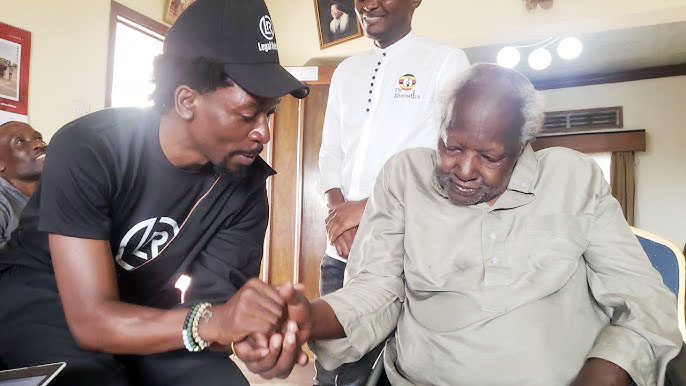
KAMPALA— When Justice George Wilson Kanyeihamba died on July 14, 2025, at the age of 85, Uganda lost not just a legal mind but one of its fiercest defenders of constitutionalism. For nearly a month, he had been in intensive care at Nakasero Hospital, battling complications from diabetes. By the time the news broke, a wave of tributes flooded in—some grieving the jurist, others reflecting on the legacy of a man who dared to speak truth in the halls of power.
Justice Kanyeihamba, often described as principled to a fault, lived through Uganda’s most turbulent decades with a legal compass few dared to follow so precisely. From drafting the nation’s 1995 Constitution to calling out abuse of judicial power—even under the government he once served—his life was a study in courage, scholarship, and defiance.
A Son of the Hills, A Mind for the Law
Born on August 11, 1939, in Kinaba, Kinkizi District (now part of Kanungu), Kanyeihamba was the 11th child in a rural, devout Anglican family. His father, Zakaliya Bafwokworora, and mother, Kyenda Malyamu Kyakundwa, had little material wealth, but instilled in their son the discipline and hunger for education that would guide his life.
He began his schooling in the hills of Kigezi—at Hamurwa Church School and later Nyaruhanga Anglican Church Primary School—before moving on to Kigezi High School and eventually Busoga College Mwiri. His academic promise took him abroad to Portsmouth University for his Bachelor of Laws and, later, to the University of Warwick in the UK, where he earned a PhD in the 1970s. In 2008, Warwick awarded him an honorary Doctor of Laws in recognition of his lifelong contributions to justice.
But for all his accolades abroad, Kanyeihamba remained deeply tethered to Uganda’s legal and civic life. As Isaac Ssemakadde, President of the Uganda Law Society, poignantly stated in a July 14, 2025, press release: “Justice Kanyeihamba was a colossus of the 1995 Constitution of the Republic of Uganda. His legacy will continue to inspire generations of lawyers and judges.”
From Lawmaker to Law Defender
Kanyeihamba’s influence in Uganda extended far beyond the classroom or courtroom. As Minister of Commerce, Minister of Justice, and Attorney General under President Museveni, he navigated the political trenches. But it was his work as chair of the Legal Committee of the Constituent Assembly—tasked with drafting the 1995 Constitution—that cemented his place in the nation’s legal history.
The document, widely hailed for its clarity and commitment to human rights, would become both his proudest achievement and the battleground for many of his later legal fights.
A Judge Who Voted His Conscience
In 1997, Kanyeihamba was appointed to the Supreme Court of Uganda, where he served until his retirement in 2009. But it was the 2006 presidential election petition that defined his time on the bench.
In a sharply divided court, Kanyeihamba was among the minority who found the electoral process so flawed it merited nullifying President Museveni’s re-election. It was a lonely, principled position—one that many believe cost him a seat on the African Court on Human and Peoples’ Rights.
His outspokenness wasn’t limited to the courtroom. In 2007, during the infamous “Black Mamba” raid on the High Court—when armed security officers stormed in to re-arrest treason suspects released on bail—Kanyeihamba called the act “an affront to the independence of the judiciary.” It was a rare rebuke from a judge against the state, and it reverberated.
The Professor in Robes
Justice Kanyeihamba’s passion for the law wasn’t confined to rulings and reports. He was, first and last, a teacher. From his days lecturing at Makerere University to his role as chancellor of both Kampala International University and Kabale University, he shaped minds with the same zeal he brought to legal debates.
His seminal text, Constitutional and Political History of Uganda, remains essential reading for law students and scholars. “Standing in the halls where he once taught, you feel the weight of his ideas,” said Moses Omujugujugu, a legal clinician. “He taught us not only how to read the law, but how to live it.”
He also served in a string of national and international roles—from Chair of the International Commission of Jurists’ Advisory Panel to Legal Adviser to the President on Human Rights. His career was expansive but always rooted in principle.
Even in retirement, Kanyeihamba remained a vocal critic of constitutional amendments and power consolidation. He repeatedly warned against the erosion of term limits and judicial autonomy. His commentaries, often published in local newspapers, were unflinching.
An Enduring Legacy
As tributes poured in from across the country, the common refrain was clear: Uganda had lost a giant. The Uganda Law Society’s press release captured the national sentiment: “Let’s honour his memory by upholding the principles of truth and justice he relentlessly championed.”
Political leaders, lawyers, and citizens across the spectrum echoed the call, describing him as a “fierce leader” and a “towering figure in Uganda’s legal and judicial landscape.”
But perhaps the most powerful legacy of Justice George W. Kanyeihamba lies in his refusal to be compromised. In a country where legal opinions can often follow the wind of political fortune, he was, as one law student put it, “a fixed point in a spinning world.”
His work will outlive him—in textbooks, in court decisions, and in the hearts of those who believe the law must serve the people, not power.
As Uganda prepares to honor him with a state funeral, one hopes his legacy doesn’t rest in marble, but in the quiet courage of the next judge who dares to dissent, the next law student who dares to question, and the next citizen who demands justice.