
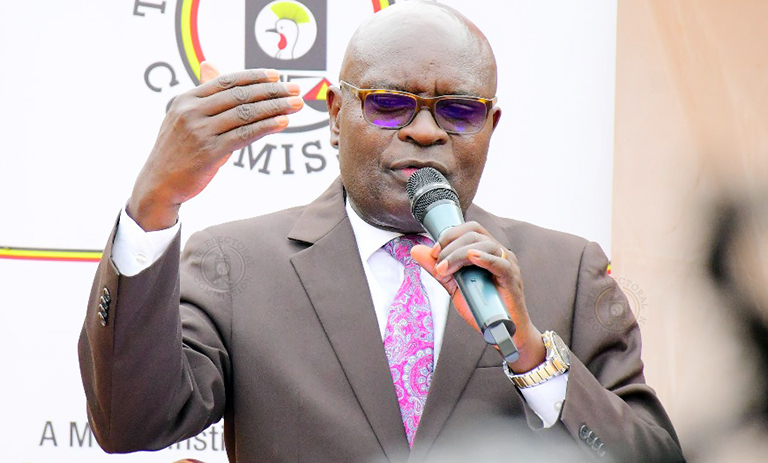
KAMPALA— In a detailed and consequential press briefing on June 18, 2025, Justice Simon Byabakama Mugenyi, Chairperson of the Electoral Commission (EC), delivered a sweeping update on Uganda’s ongoing electoral roadmap—laying out both immediate action points and broader legal directives for the 2025/2026 General Elections.
From the progression of Special Interest Group (SIG) elections to strict deadlines for aspiring candidates’ qualifications and resignations, Byabakama’s statement served as a roadmap, a legal caution, and a civic call to order in one.
Youth, PWD, and Older Persons Vote in Massive SIG Exercise
With polling already underway for Special Interest Group Committees at the village level, the EC announced that voting for older persons and persons with disabilities (PWDs) took place on June 16 and 17 respectively, with youth committee elections scheduled for Thursday, June 19.
These elections cover all 71,208 villages in Uganda and are conducted through a simplified but powerful method: voters line up behind the candidate or their portrait. “The reports we have received… indicate that the concluded village committee elections were peaceful and conducted in an atmosphere of tranquility,” said Byabakama.
The elected SIG committees form part of Uganda’s effort to ensure inclusive representation in governance, empowering historically marginalized groups with grassroots political agency.
Escalating Concerns: Youth Brigades and Electoral Violence
While praising the peaceful conduct so far, Byabakama raised a red flag over emerging reports of candidates forming informal security outfits, often referred to as “youth brigades,” to protect votes or intimidate rivals. “These are irresponsible acts,” he warned. “Only the Uganda Police is mandated to provide security during the electoral process.”
He cautioned political parties and independents against forming parallel security structures, which he described as unconstitutional and destabilizing. The Commission’s message to the youth was clear and urgent: participate, but do so peacefully and lawfully. “Elections bring winners and losers, but that should not divide us,” he reminded the public. “Our country must remain united and peaceful.”
What Aspirants Must Know: Academic Proof, Resignation Deadlines, and Legal Traps
Beyond the SIG elections, the press conference laid out legal guardrails for anyone aspiring to run for office at all levels in 2025/26. Whether aiming for the presidency, a parliamentary seat, or a local government post, aspirants must meet strict timelines for resigning from public service and verifying their academic qualifications.
Those intending to contest must not only hold an advanced-level education (or its equivalent) but also verify those qualifications with the National Council for Higher Education (NCHE) and Uganda National Examinations Board (UNEB)—especially if they were obtained abroad or claimed as equivalents.
Importantly, even those who had their qualifications verified in past elections must re-verify them for 2025/2026. “The Electoral Commission shall not accept a statutory declaration or affidavit as evidence of an academic qualification,” Byabakama firmly stated.
The Commission also provided a list of deadlines:
- Presidential Aspirants: Must establish academic qualifications by August 1, 2025
- Parliamentary Aspirants: July 16, 2025
- District Chairpersons: July 3, 2025
Failure to comply renders nomination papers void—meaning disqualification at the gates.
The Resignation Rule: Who Must Leave and When
Equally pressing is the requirement for public servants and employees of government-controlled entities to resign before seeking elective office. For example:
- Presidential aspirants must resign before October 1, 2025
- MPs: by June 13, 2025
- District Chairpersons: by August 2, 2025
- SIG Candidates: by April 28, 2025
Resignation letters and evidence of receipt must be presented during nomination—no exceptions.
The Military, Police, Civil Service, and Culture: No Politics Allowed
The Commission reiterated constitutional boundaries: individuals in the armed forces, police, prisons service, civil service, and traditional or cultural institutions are barred from engaging in partisan politics. This includes holding office in political parties, canvassing support, or even speaking publicly on politically controversial matters.
Party Endorsements and Nominations: Clear Protocols
For political party-sponsored candidates, the Commission emphasized that nomination papers must be officially sealed and endorsed by the party’s Secretary General or a designated official. These appointments must be communicated to both the EC headquarters and relevant district returning officers in advance of nomination day.
A High-Stakes Moment for Uganda
Byabakama’s address wasn’t just procedural—it was a sobering reminder of the scale and complexity of Uganda’s electoral process. The EC is managing a constitutional marathon that spans everything from SIG grassroots elections to presidential aspirant vetting.
Yet, at the heart of this bureaucratic rigour lies a human story: one of youth eager to serve, communities longing for safety and representation, and a country grappling with democratic accountability in real time.
The EC Chair concluded with a call to unity. “Let us make sure that we keep the country peaceful, united, and progressing,” he said.
With months to go before general elections, the clock is ticking—and the choices, legal responsibilities, and civic duties have never been clearer.