
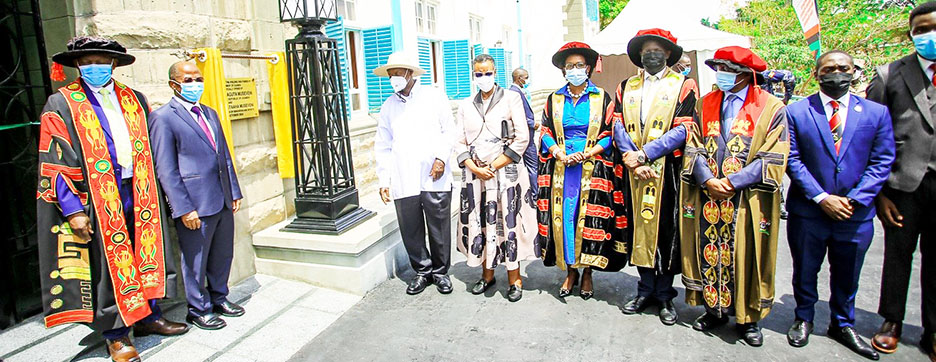
MAKERERE: Just days after Dr. Crispus Kiyonga’s installation as Chancellor of Makerere University on October 2, 2024, the institution faces a major disruption. The Makerere University Joint Staff Associations, comprising the Makerere University Academic Staff Association (MUASA), Makerere University Administrative Staff Association (MASA), and the National Union of Education Institutions (NUEI)-Makerere Branch, initiated a strike on October 7, 2024, withdrawing their labor in response to unresolved salary harmonization issues.
Following a general assembly held to assess the progress of the university’s salary harmonization plan, the staff associations resolved to cease work starting at 1:00 p.m. on October 7. The decision came after what they described as unfulfilled commitments from the university management regarding the harmonization of salaries.
In a letter addressed to the Chairperson of the Makerere University Council, Ms. Lorna Magara, the Joint Staff Associations outlined their conditions for resuming work, demanding that: The total amount of UGX 12,636,589,200 earmarked for salary harmonization should be paid to all eligible staff, following calculations made by management, approved by the University Council, and included in the Government of Uganda’s FY 2024/2025 budget, along with any arrears.
Additionally, decisions by the Appointments Board that have resulted in the demotion of staff to lower ranks must be reversed immediately, ensuring that staff members currently occupying senior positions are not disadvantaged by being lowered in rank as part of the harmonization process. Staff in upgraded positions should receive their new salary scales without the requirement of additional qualifications that were not part of their original recruitment or promotion criteria. And any new qualification requirements, as directed by the Ministry of Public Service, should not be applied retroactively to current staff. Additionally, all letters issued regarding salary harmonization should be revised to include the precise salary amounts corresponding to each designated salary scale.
The associations accused the university management of failing to honor its commitment to implement salary harmonization by the promised deadline of September 30, 2024, which marked the end of the fiscal quarter. They further alleged that the university has demoted numerous staff members under the guise of harmonization while issuing incomplete letters that specify salary scales without including the corresponding figures, calling it a “ploy to defraud staff.”
In their letter, the staff associations also criticized the university management for what they described as a “toxic working environment.” They accused the administration, in collaboration with the Uganda Police, of obstructing the Joint Staff Association General Assembly that was scheduled for October 7. This, they argued, constituted a violation of their rights to freedom of assembly and association, further exacerbating tensions within the university.
The ongoing strike poses a significant challenge for Makerere University’s management, coming at a time when the institution had just celebrated the installation of its new chancellor. As the standoff continues, the university faces growing pressure to address the demands of its staff and resolve the grievances that have disrupted operations.
The ongoing labor strike at Makerere University continues to cast a shadow over the institution’s operations, with the Makerere University Academic Staff Association (MUASA) making their demands clear. According to Dr. Robert Kakuru, the Chairperson of MUASA, the staff associations have outlined their grievances in a detailed five-page document. The focus of the demands is on salary harmonization, an issue that has long been a point of contention between the university staff and administration.
“The standoff will not end until our resolutions are addressed,” emphasized Dr. Kakuru, underscoring the determination of the staff to see their concerns met. He highlighted that the issues at hand have been carefully elaborated, aiming to bring clarity to the challenges that have fueled the unrest.
The dissatisfaction among staff members is palpable. “The staff at Makerere University, especially those affected by the non-harmonized salary, are disgruntled, and they have a point,” said one staff member who wished to remain anonymous. “When the staff at one of the top 10 universities in Africa are disgruntled, the effects are widespread.”
This frustration is most keenly felt by the university’s students, who bear the brunt of the strike’s impact. The anonymous staff member further explained, “I want to focus on the effect on the students, who, in my opinion, are the primary stakeholders. Students come here to attain an education, which is heavily dependent on the presence and performance of the staff. If the staff are absent—understandably due to their grievances—students are left in a difficult situation. The most immediate impact is on the everyday student, who goes to class only to find no lecturer, attempts to use a washroom but finds it unclean, or navigates through a dirty residence hall to reach their room. The student’s life becomes unbearable, and they are exposed to unsanitary conditions.”
Muhammad Jjumba, a student at the university, echoed these concerns. “The withdrawal of labor by Makerere University staff is likely to cause significant disruption to learning—halting lectures, assessments, and administrative functions. This leads to delays in student progress and, consequently, could trigger protests and demonstrations as students push both staff and administration to resolve the strike. Given the history of Makerere, such unrest on campus is almost predictable.”
The call for salary harmonization and fair compensation is not new among Makerere University staff. The Joint Staff Associations have long advocated for a structured pay system that ensures fair wages for lecturers and professors. In 2016, the academic staff laid down their tools in protest, demanding the payment of incentive arrears. The strike led to the closure of the university for over five months, following a directive from the President of Uganda.
As the current strike unfolds, the echoes of past protests serve as a reminder of the deep-rooted issues that continue to challenge the administration. With students and staff caught in the crossfire, the pressure is mounting for a resolution that addresses the demands of the staff while ensuring that students’ educational needs are not sidelined. The outcome of this standoff will shape the future of Makerere University’s academic environment, with stakeholders hoping for a solution that balances the interests of all parties involved.