
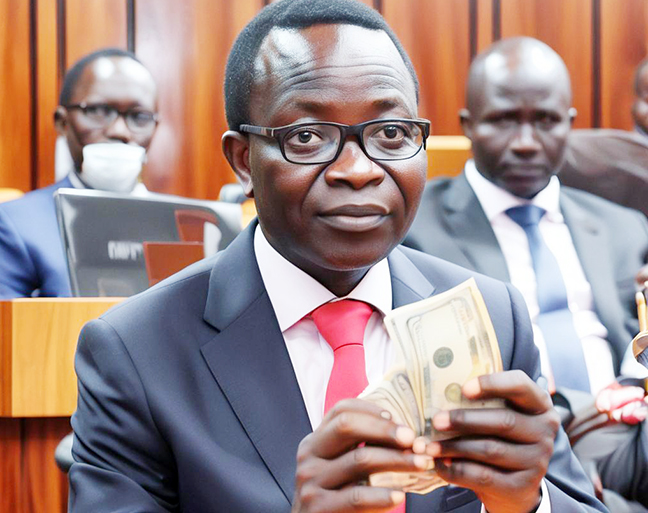
KAMPALA – By December 2023, Uganda’s public debt surged to USD 24.69 billion (UGX 93.38 trillion), marking a significant rise from the USD 21.74 billion (UGX 80.77 trillion) recorded at the end of December 2022. This 13.6 percent increase in debt stock over the year was primarily driven by substantial loan disbursements and heightened domestic borrowing to meet budgetary demands. The latest figures were revealed in the Ministry of Finance’s Medium-Term Debt Management Strategy (MTDS) report for the fiscal years 2024/25 to 2027/28.
“The notable increase in external debt was largely due to budget financing loans, including a substantial USD 545.45 million from Stanbic Bank, coupled with an IMF extended credit facility and SDR drawdown totaling USD 370.64 million,” the report stated. Meanwhile, the rise in domestic debt was necessitated by increased government expenditure requirements, leading to additional borrowing from the domestic market.
The MTDS report highlighted that the nominal value of public debt as a percentage of GDP marginally increased to 49.9 percent from 49.6 percent in December 2022. Out of the total debt stock, external debt accounted for 59.3 percent (USD 14.64 billion), while domestic debt constituted 40.7 percent (USD 10.05 billion).
Composition of Government Debt
By the end of December 2023, Uganda’s domestic debt stock was UGX 38.09 trillion. Treasury Bills, which include government securities with durations of 91, 182, and 364 days, comprised 16.1 percent (UGX 6.1 trillion) of this debt. Treasury Bonds, with durations ranging from 2 to 20 years, made up the remaining 83.9 percent (UGX 31.89 trillion). The government’s strategy of issuing longer-dated instruments to mitigate refinancing risk saw 10- and 15-year Treasury Bonds making up 46.25 percent of the domestic debt stock, according to the MTDS report.
Multilateral creditors held the largest portion of Uganda’s external debt, at 62.85 percent (USD 9.20 billion). The International Development Association (IDA), International Monetary Fund (IMF), and African Development Fund (AfDF) were the major multilateral creditors, collectively holding USD 7.73 billion, or 52.77 percent of the external debt portfolio. Other significant multilateral creditors included the African Development Bank (ADB), Islamic Development Bank (IDB), and International Fund for Agriculture (IFAD), holding 10.08 percent (USD 1.48 billion).
Bilateral creditors, categorized into Paris Club and non-Paris Club, held 6.48 percent (USD 0.95 billion) and 17.88 percent (USD 2.62 billion) of the external debt, respectively. Private banks and development finance institutions like AFREXIM and Stanbic Bank accounted for 12.80 percent (USD 1.87 billion). Notably, Exim Bank of China and UKEF were the dominant bilateral creditors, with holdings of USD 2.51 billion and USD 0.37 billion, respectively.
Implications and Future Strategy
The rise in Uganda’s public debt poses significant challenges. However, the MTDS outlines strategies to manage these risks. “The Government will effectively manage borrowing costs and risks by determining the appropriate balance between domestic and external borrowing,” the report states. This strategy includes a planned reduction in Net Domestic Financing (NDF) and exploring alternative financing options with competitive rates.
Furthermore, the currency composition of Uganda’s debt portfolio was predominantly in Uganda shillings (40.71 percent), followed by USD-denominated debt (28.97%) and EUR-denominated debt (19.11 percent).
As Uganda navigates these financial challenges, the government’s approach to debt management will be crucial in maintaining economic stability. The MTDS report emphasizes the importance of a systematic decision-making process to enhance debt management and reduce operational risks.
By adopting a strategic approach to debt management, Uganda aims to secure the necessary financing for its budgetary needs while minimizing the financial burden on the economy. As highlighted by the report, balancing borrowing costs and risks through a mix of domestic and external sources is essential for the country’s financial health and sustainability.
Conclusion
Uganda’s public debt has reached unprecedented levels, necessitating a strategic and balanced approach to debt management. With significant portions of debt held by multilateral and bilateral creditors, and a rising share from private banks, the government’s focus on cost-effective borrowing and risk mitigation will be critical in ensuring economic stability and sustainable growth.