

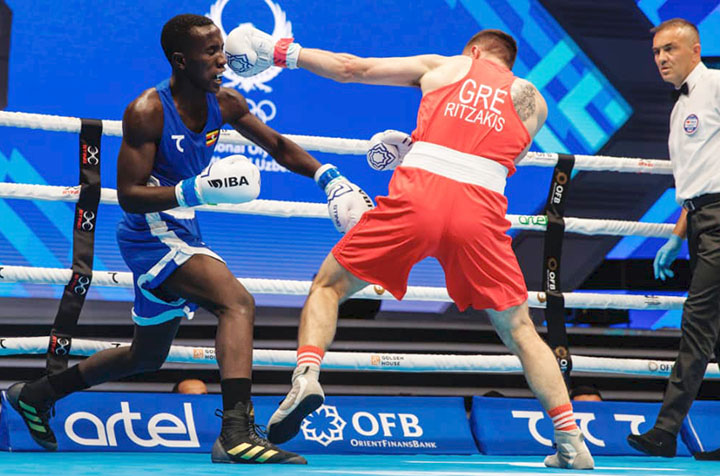
The International Olympic Committee (IOC)’s decision to expel the International Boxing Association (IBA) from the Olympic Movement on June 23 leaves the future of amateur boxers in limbo.
Uganda is one of the countries affiliated to both the IOC and IBA; hence the latest decision bears direct impact on the local pugilists under the Uganda Boxing Federation (UBF) umbrella.
In the past Uganda has produced Olympic medalists such as Eridad Mukwanga, Leo Rwabogo and John ‘The Beast’ Mugabi.
Furthermore, Moses Muhangi, the current president of UBF, is a close ally of the Umar Kremlev, the troubled Russian head of IBA.
In a press statement, IOC stated that IBA failed to complete reforms on governance, finance and ethical issues.
The final bell sounded for the amateur boxing body after the IOC polled on June 22 in Geneva, Switzerland to expel the IBA from the Olympic movement, with 69 members backing the decision against a single vote in an exercised where 10 abstained, setting history as the first time the Olympic Committee had kicked out a governing body in its 129-year of existence.
However, the IOC president, Thomas Bach, confirmed boxing would remain in the 2024 and 2028 Olympics, even though it now lacks an international federation to run the sport.
“We do not have a problem with boxing, we do not have a problem with boxers,” he told an extraordinary IOC session, adding: “On the contrary, we appreciate the boxers for living the values of their sport.”
“If we had a problem with boxers there would not have been a competition in Tokyo. There would be no boxing competition in Paris.”
The expulsion had been on the cards since 2019 when the IOC withdrew its recognition for the IBA ( then called Aiba) due to concerns over judging and refereeing, financial stability and governance. The move followed a number of allegations of rigged decisions at the Rio 2016 Olympics and financial mismanagement under its former president CK Wu.
The IBA then further antagonised the IOC by choosing the Uzbek Gafur Rakhimov to run the sport. Rakhimov was described by the United States of America’s Department of the Treasury as one of his country’s ‘leading criminals’ and ‘an important person involved in the heroin trade,’ allegations he denied.
In 2020, Rakhimov was replaced by the Russian Umar Kremlev, but the IOC said that under his watch the IBA had repeatedly failed to address its concerns. Notably, in a 24-page report detailing all of the steps it had required the IBA to take to regain its status to run Olympic boxing – and which it had failed to do – it accused the IBA of “open intimidation towards the IOC.”
“We highly value the sport of boxing but unfortunately we have an extremely serious problem with the IBA because of their governance,” said Bach. “We believe the boxers fully deserve to be governed by an international federation with integrity and transparency.”
IBA REACTS
That was a message reinforced by the IOC director general, Christophe De Kepper, who said the IBA had not addressed its worries over corruption, finances and refereeing and judging. “The IOC has constantly and patiently tried to help in the three areas of concern,” he said.
“There has been a constant lack of drastic revolution throughout the many years. It is a situation of no return. The only conclusion is to withdraw recognition.”
In response, IBA said they are considering seeking legal redress and accused IOC of being ‘political.’
“The IOC has made a tremendous error by withdrawing its recognition of the IBA, revealing its true politicised nature,” it added in a statement. “It is noteworthy that on this very day, 82 years ago, fascist Germany launched an attack on the peaceful citizens of the Soviet Union, resulting in the escalation of war and a devastating human tragedy.
“We cannot conceal the fact that today’s decision is catastrophic for global boxing and blatantly contradicts the IOC’s claims of acting in the best interests of boxing and athletes.”
