
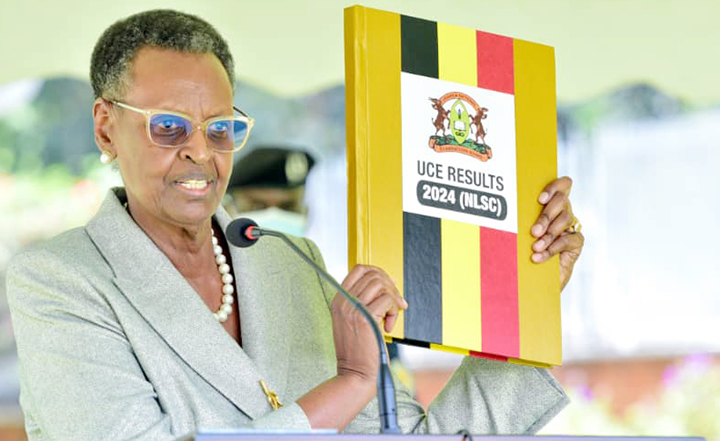
Kampala – February 11, 2025 – The Uganda National Examinations Board (UNEB) presented the results for the first cohort under the Competency-Based Curriculum (CBC), which was introduced in 2020. This curriculum focuses on holistic learner assessment, covering cognitive, affective, and psychomotor domains, emphasizing real-life applications of knowledge and skills. The CBC aims to shift the educational focus from rote memorization to holistic learning, and prioritizes the practical application of knowledge, preparing students for real-world problem-solving.
The results reflect a promising start for the CBC, with an impressive 98.05 percent of candidates qualifying for the UCE certificate. Subjects such as Art & Design, History, and Agriculture thrived under the new curriculum, benefiting from the emphasis on creativity and hands-on learning. However, the transition has not been without challenges. Physics and Chemistry emerged as problematic areas, hindered by resource shortages, a lack of qualified science teachers, and schools’ resistance to adopting the new curriculum.
This year’s results offer a glimpse into how Uganda’s education system is adapting to this transformative approach.
Implementation Challenges and Key Reforms
Implementing the CBC was no small feat. UNEB undertook the massive task of training over 63,000 teachers in continuous assessment (CA) and project work. However, the transition wasn’t without its hurdles. Many schools, especially in rural and private sectors, struggled with IT infrastructure gaps that hindered the timely submission of CA scores. UNEB itself faced server capacity challenges due to the vast amount of data being processed for the new system.
A more pressing issue, according to a statement read by Dan N. Odongo, the executive director of UNEB, was the shortage of laboratory facilities and qualified science teachers, which directly impacted the CBC’s emphasis on practical, hands-on learning. This was particularly felt in science subjects, where students struggled with experimental and application-based assessments. Odong said resistance to the new curriculum also posed a significant barrier as some schools continued to teach the old syllabus, hoping for a government retraction. This reluctance, especially in adopting new science methodologies, contributed to lower performance in subjects like physics and chemistry.
Despite these obstacles, UNEB introduced several key reforms. A new letter grading system (A, B, C, D, E) replaced the traditional divisional rankings, aligning with the CBC’s goal of evaluating competency levels rather than rote memorization. Project work became a mandatory component, assessed separately and reflected on student certificates. However, UNEB also faced scorer strikes, with examiners demanding higher pay due to the increased complexity of grading under the new system. In response, UNEB recommended training more scorers and raising scoring fees across subjects to maintain fairness and accuracy.
Statistical Overview: A High Success Rate Amid Challenges
Despite the growing pains, the overall performance under the CBC was remarkably strong. Out of 359,417 candidates registered for the exams, an impressive 98.05 percent (or 350,146 candidates) qualified for the UCE certificate. This high success rate reflects both the effectiveness of the CBC and the resilience of students and educators in adapting to the new system.
The results were classified into three categories. Result 1 represented candidates who met all certification requirements, including completing continuous assessment, submitting project work, and sitting for all compulsory subjects. These students received their UCE certificates with detailed transcripts reflecting their performance. Result 2 was designated for candidates who missed key requirements, such as failing to sit for core subjects or neglecting project work, while Result 3 applied to those who scored an elementary grade (E) across all subjects, demonstrating a lack of basic competency.
A standout feature of this year’s results was the inclusivity achieved under the CBC. 743 candidates with Special Needs Education (SNE), including the blind, deaf, dyslexic, and physically handicapped, participated in the exams. An overwhelming 95.3 percent of these candidates qualified for certificates, with all deaf candidates achieving certification. Furthermore, prison inmates also demonstrated remarkable success; 28 candidates from Uganda Government Upper Prison (Luzira) and 11 from Mbarara Main Prison all passed their exams, qualifying for UCE certificates.
Successes and Struggles
The shift to the CBC reshaped performance trends across various subjects. Art & Design, History & Political Education, and Agriculture stood out as subjects where students excelled. In Art & Design, 13 percent of candidates achieved Grade A (exceptional), and 42.5 percent secured Grade B (outstanding). The practical, creative nature of this subject aligned seamlessly with the CBC’s focus on real-life application, fostering higher achievement.
History & Political Education also saw strong performance, with 6.4 percent achieving Grade A and 22.3 percent securing Grade B. The subjects’ emphasis on critical thinking and analytical skills resonated with the CBC’s core competencies, contributing to these results. Agriculture similarly benefited from its hands-on approach, with 4.7 percent of candidates attaining Grade A and 50.3 percent achieving Grade B, demonstrating the positive impact of practical fieldwork and problem-solving on academic performance.
However, not all subjects fared as well under the new system. Physics and chemistry emerged as challenging subjects, reflecting broader issues in the education system. In Physics, only 1.9 percent of candidates achieved Grade A, and 12.8 percent scored Grade E (Elementary), indicating significant struggles with experimental applications and problem-solving. Chemistry presented similar challenges, with just 1.0 percent attaining Grade A and 6.1 percent scoring Grade E. The lack of laboratory resources and qualified science teachers, particularly in rural schools, hindered students’ ability to engage with practical components effectively.
Even in the English Language, traditionally a strong subject, performance was mixed. While 2.7 percent of candidates achieved Grade A, 3.6 percent scored Grade E, struggling with comprehension, critical thinking, and original expression. Many students relied heavily on rote learning, finding it difficult to construct coherent arguments and apply literary analysis, key skills emphasized by the CBC.
Gender Performance Trends: A Shift in Dynamics
The CBC results revealed interesting gender dynamics. Female candidates outperformed their male counterparts in subjects such as English Language, Christian Religious Education, and Art & Design. This may be attributed to the strong communication and creative skills emphasized in these subjects, areas where female students traditionally excel.
Conversely, male candidates performed better in history, geography, mathematics, and sciences. The emphasis on analytical and problem-solving skills in these subjects may have contributed to this trend, though it also reflects broader societal expectations and access to resources that may favor boys in certain academic disciplines.
Candidate Feedback: A Mixed Reception
Feedback from candidates provided valuable insights into the CBC’s implementation. A survey of 50,631 candidates revealed that 94.6 percent felt exam items were drawn from covered syllabus areas, and 83.2 percent found the exam questions clear. However, 31.9 percent of students described the exams as difficult, while 60.1 percent found them fair.
While many students appreciated the practical approach and real-life application of knowledge, others struggled with time management and adapting to the new assessment techniques. The CBC’s focus on critical thinking over memorization presented challenges for students accustomed to traditional learning methods.
Examination Malpractice: A Positive Decline
One of the bright spots in this year’s results was the significant reduction in examination malpractice. Only 984 candidates were implicated, a stark decrease from nearly 3,000 cases in the previous year. However, 93.1 percent of malpractice cases occurred in science practical exams, particularly physics, where teachers were found providing experimental results for students to copy.
While this reduction is encouraging, UNEB must continue to strengthen exam integrity, especially in science subjects, by improving teacher training and supervision during practical assessments.
A Promising Start with Room for Growth
The release of the 2024 UCE results marks a promising start for Uganda’s competency-based curriculum. The high success rate, the inclusivity of special needs candidates, and the reduction in malpractice all point to a positive trajectory. Subjects like Art & Design, History, and Agriculture showcase the curriculum’s potential to foster practical skills and real-life problem-solving.
However, the challenges in science subjects, language competencies, and infrastructure highlight areas needing urgent attention. Addressing teacher training gaps, improving resource allocation, and fostering adaptation to the new curriculum will be crucial in ensuring the CBC achieves its full potential. As Uganda continues this educational transformation, the lessons from this first cohort will pave the way for more robust, inclusive, and practical learning experiences for future generations.