
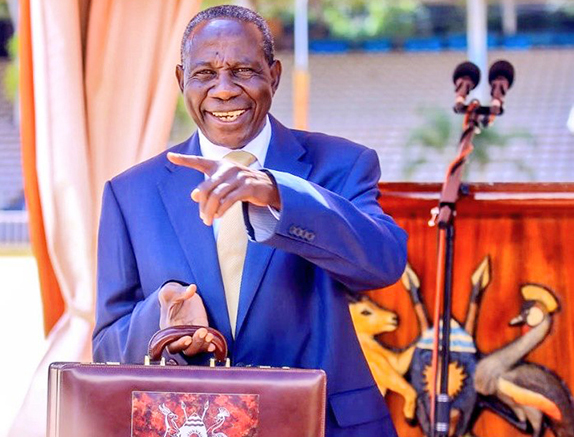
KAMPALA— In a year marked by global economic uncertainty and domestic reform fatigue, Uganda’s Finance Minister, Matia Kasaija, stepped onto the parliamentary floor on June 12 with a speech not just about fiscal numbers, but about vision, legacy, and transformation. As he presented the Shs 72.1 trillion national budget for FY 2025/26, he framed it as both a reckoning and a launchpad—an “accountability” report for the first half of Uganda’s Vision 2040, and a springboard into what he called the “Tenfold Growth Strategy” for the future.
At the core of his message was a nation standing at a self-declared inflection point. Uganda, he claimed, is on the verge of becoming the world’s fastest-growing economy by 2031, according to the Harvard Growth Lab. With Gross Domestic Product (GDP) projected to rise from USD 61.3 billion this year to USD 500 billion by 2040, the budget is not merely about keeping the lights on—it is about scaling the system.
But behind the optimism lies a more complex picture—one of impressive gains shadowed by structural challenges, and bold fiscal ambitions constrained by legacy inefficiencies. The budget, while a confident pitch to investors and development partners, is also a test of Uganda’s ability to execute at scale.
From Stabilization to Acceleration
The budget speech doubled as a retrospective on the last 15 years of the National Resistance Movement (NRM)’s economic stewardship. Minister Kasaija revisited Uganda’s path from post-conflict stabilization in the early 2000s to the implementation of three consecutive National Development Plans (NDP I–III), which he said laid the foundation for the transformation now underway.
According to the government, Uganda’s economy has more than tripled since 2010—from Shs 64.8 trillion to Shs 226.3 trillion. This economic expansion has coincided with meaningful improvements in social indicators: life expectancy has climbed to 68.2 years, up from 50.4 in 2002; poverty has fallen to 16.1 percent from 24.5 percent in 2010/11; and the country has met the criteria to graduate from Least Developed Country (LDC) status.
These outcomes, the minister argued, are not incidental but the result of a deliberate strategy rooted in four ideological pillars: socio-economic transformation, patriotism, Pan-Africanism, and democracy. It is a narrative of continuity and purpose—but also one that must now confront the reality of implementation fatigue, budget absorption constraints, and the rising expectations of an increasingly connected population.
The Tenfold Dream
The next chapter, as outlined in the Fourth National Development Plan (NDP IV) and the overarching Vision 2040, is unapologetically ambitious. The government intends to increase the size of Uganda’s economy more than eightfold in the next 15 years. This would require an average annual growth rate far beyond historical norms and consistent inflows of both domestic and foreign capital.
To get there, the budget places emphasis on full monetization of the economy—transforming informal, subsistence livelihoods into commercial enterprises. The strategic pillars? Commercial agriculture, industrialization, expanded services, digital transformation, and improved market access.
There are signs of momentum. The manufacturing base has grown, with over 18,000 new factories added since 2010. Electricity generation capacity has quadrupled to over 2,000 megawatts. Internet penetration has surged from just under 2 percent in 2010 to 53 percent in 2022, fueled by a national ICT backbone stretching over 4,300 kilometers. Uganda’s export basket is also diversifying, adding 31 new products in the past 15 years, including pharmaceuticals, ceramics, processed food, and textiles.
These are not minor milestones. They reflect an economy gradually shifting from its historical dependence on the “3Cs” (coffee, cotton, copper) and “3Ts” (tobacco, tea, tourism) toward a broader industrial and digital base.
But Who Pays—and How?
Beneath the optimism, however, lies a sober question: how will all of this be financed?
The FY 2025/26 budget will be 60 percent funded through domestic revenue—an unprecedented shift that places increasing pressure on Uganda’s tax system and business community. While this reduces reliance on donors and concessional borrowing, it raises the stakes for the Uganda Revenue Authority’s enforcement strategy. The rollout of digital compliance tools and AI-enabled tax audits reflects the government’s intent to expand the formal tax net—but could risk overwhelming SMEs and informal businesses not yet ready for full integration.
At the same time, the government is managing its debt portfolio cautiously. While concessional and domestic borrowing continue, the finance ministry has insisted this borrowing will be “strategic”—channeled into productive sectors and on-lent through development banks like UDB. But critics warn that public investment must deliver measurable returns, or Uganda risks repeating past cycles of debt-led stagnation.
Infrastructure, Yes. Institutions?
Much of the budget focuses on tangible infrastructure—roads, electricity, industrial parks, and broadband—but institutional reform gets less airtime. While the expansion of physical access is welcome, efficiency in public service delivery remains a pain point. Poor procurement systems, delayed project execution, and corruption continue to undermine Uganda’s development momentum.
Even the social sectors, though funded more generously this year—with Shs 5.87 trillion for health and Shs 5.04 trillion for education—are still haunted by delivery bottlenecks. Schools and hospitals are being built, but staffing, equipment, and quality assurance lag behind. Without stronger oversight, budget allocations may fail to translate into impact on the ground.
What the World Is Watching
International observers see Uganda’s trajectory with cautious optimism. The country’s demographics are favorable, its natural resources abundant, and its regional position strategic. The recent graduation from LDC status could open access to new financing and trade opportunities, but it also removes some preferential treatment, raising the pressure to compete on merit.
Investors, meanwhile, are paying attention to signals in the budget—particularly around industrial policy, digital inclusion, and the regulatory environment. Uganda’s drive toward local value addition, export diversification, and infrastructure development aligns with broader African economic trends. But success will depend on political will, bureaucratic coordination, and the ability to manage risks—both fiscal and social.