

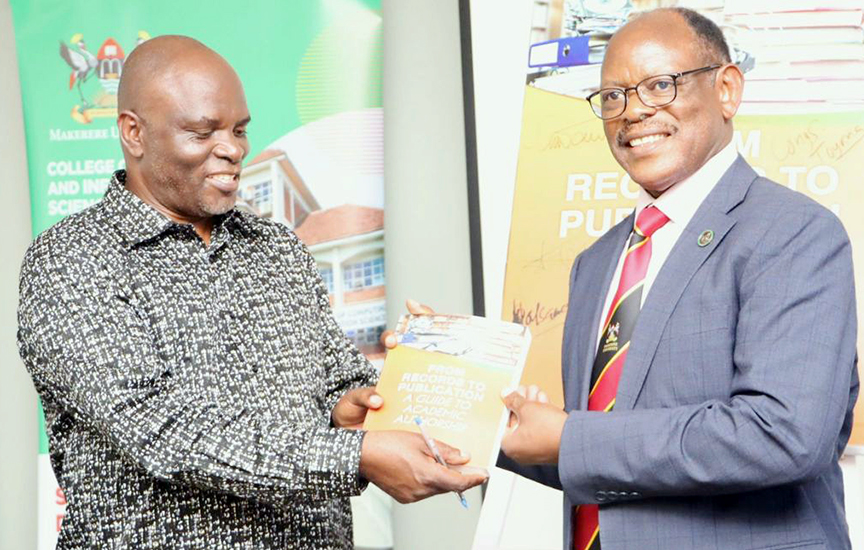
MAKERERE – On a campus long regarded as East Africa’s intellectual heartbeat, the launch of a book about writing might have seemed like a quiet affair. There were no laboratory breakthroughs, no new satellite images, no billion-dollar grants announced. Just a title projected onto a screen at Makerere University: From Records to Publication: A Guide to Academic Authorship.
But beneath that modest unveiling lay a more urgent ambition. For Makerere, and for Africa more broadly, this was not simply a book launch. It was an intervention.
“Africa still produces only three percent of global academic publications,” Makerere’s Vice Chancellor, Professor Barnabas Nawangwe, reminded the audience. The figure is stark, especially when placed alongside another: the continent accounts for roughly fifteen percent of the world’s population. The imbalance is not just statistical. It shapes whose ideas circulate globally, whose histories are archived, and whose knowledge informs policy and innovation.
“Slavery and colonialism cannot simply be brushed aside,” Nawangwe said, pointing to 400 years of slavery and 200 years of colonial rule as part of the historical weight Africa continues to carry. “Yet, we Africans have not written enough about these histories. We must invest in research, publication, and innovation to move Africa forward and claim our rightful place in global scholarship.”
The new volume, edited by Professor Elisam Magara, a specialist in records and archives management, is positioned as a practical answer to that call. Published by Makerere University Press, it aims to demystify academic writing and publishing—processes that many young scholars describe as intimidating, opaque and unforgiving.
For generations of graduate students across Africa, the journey from research idea to published paper has felt like navigating a maze without a map. There are unspoken rules about citation styles, co-authorship, peer review, copyright permissions and publication ethics. Rejection is common. Feedback can be brutal. Costs can be prohibitive. And the prestige economy of global publishing often tilts toward institutions in Europe, North America and parts of Asia.
Magara’s book seeks to bring that hidden architecture into the open.
The project began in 2022 with an international call for contributions. Thirty submissions were received from scholars across Africa. Abstracts were peer-reviewed. Contributors attended write-shops. Chapters were revised multiple times. Those written by editors were reviewed by independent scholars to ensure objectivity. Magara credits a sabbatical leave granted by the university for allowing him to consolidate the manuscript with the focus such a work demands.
The structure of the book reflects the full lifecycle of scholarship. The opening section explores foundational questions: Where do ideas come from? How do they become structured arguments? How does one move from thought to record to publication? It delves into the philosophical basis of academic writing, examining meaning, proof and evidence—questions often assumed but rarely unpacked for emerging researchers.
The second section turns practical. It addresses ethical dilemmas, copyright and neighbouring rights, co-authorship tensions, citation and referencing standards, bibliographic control and the economics of publishing. For scholars accustomed to discovering these complexities by trial and error, the clarity is deliberate. The book treats academic writing not as an art reserved for a gifted few, but as a craft that can be learned, refined and taught.
The final section emphasizes mentorship. “You will not write alone,” Nawangwe told the audience. In many African universities, young lecturers and PhD candidates struggle in isolation, lacking structured guidance on how to convert theses into journal articles or how to navigate reviewer feedback. By foregrounding mentorship, the book acknowledges that writing is social as much as intellectual.
The timing is significant. Makerere itself has undergone a transformation in research output. According to Nawangwe, the university has increased its annual publications from around 500 a decade ago to more than 2,000 today. Its research performance has improved in international evaluations, including the Times Higher Education rankings. The growth signals both ambition and competition. African universities are under pressure not only to teach growing student populations but also to produce knowledge at a global standard.
Yet publication numbers alone do not resolve deeper structural challenges. Many African scholars still depend on journals based abroad for visibility and recognition. Nawangwe questioned that dependence directly. “Why should our authors struggle to publish in European, American, or Indian journals when we can create credible regional journals?” he asked, suggesting East African journals in records and library science as examples.
The implication is clear: academic writing is not merely about individual career advancement. It is about intellectual sovereignty. Creating credible African journals, supported by institutions like Makerere University Press, could shift the geography of knowledge production, giving African scholars greater control over peer review processes, thematic priorities and access.
The book’s contributors, drawn from Uganda, Zimbabwe, Zambia, Kenya and beyond, tackle issues that resonate across the continent: managing publication costs, navigating open access platforms, handling translation, and incorporating visual illustrations in scholarly work. By combining philosophical reflection with practical instruction, the volume acknowledges a shift in academic culture. Today’s scholars must be not only researchers but communicators, editors, digital navigators and, often, entrepreneurs of their own ideas.
There is also a generational undertone to the launch. Graduate enrolment across Africa has expanded dramatically. Yet many first-generation scholars enter doctoral programs without prior exposure to the norms of international publishing. A handbook that explains the terrain—without condescension—can be transformative.
At its core, From Records to Publication reframes writing as responsibility. For Nawangwe, the act of publishing is tied to development itself. He cited China’s rise as partly rooted in sustained investment in research and innovation. Knowledge production, he argued, is inseparable from economic and political power.
But the book’s ambition is quieter and more intimate as well. It seeks to give confidence to the hesitant doctoral student unsure whether their work is “good enough.” It offers structure to the junior lecturer staring at reviewer comments in frustration. It reminds established scholars that mentorship is not optional but essential.
Makerere’s launch, then, signals more than institutional pride. It reflects a broader continental reckoning. If Africa is to move from three percent of global publications toward a more proportionate presence, the change will not come solely from funding announcements or policy declarations. It will come from the slow, disciplined work of writing—drafting, revising, submitting, responding, publishing.
In that sense, a guidebook is not a small thing. It is infrastructure.
As Nawangwe put it, writing and publishing are “not just an academic exercise—it is a duty and a responsibility.” In a world where knowledge shapes power, the simple act of helping scholars put words to record may be one of the most consequential investments a university can make.
