
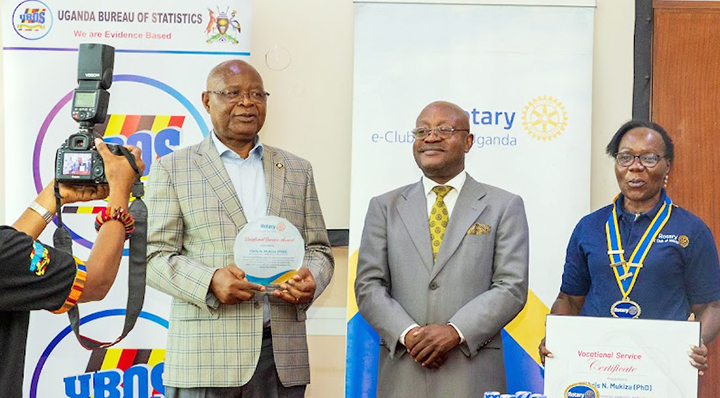
In a country where policy decisions often shape lives far beyond the boardroom, data is quietly becoming one of Uganda’s most powerful tools. This week, that reality took centre stage as Dr. Chris N. Mukiza, Executive Director of the Uganda Bureau of Statistics (UBOS), was honoured with the Rotary Vocational/Service Award—an accolade that speaks not just to individual achievement, but to the growing influence of data in how Uganda plans its future .
The award, presented at Statistics House in Kampala by the Rotary E-Club of Ntinda, brought together professionals, policymakers, and development actors. But beneath the ceremony was a deeper message: that numbers, when properly gathered and understood, can shape everything from healthcare delivery to infrastructure development.
Accepting the award, Dr. Mukiza was quick to shift the focus away from himself and onto the institution he leads. “This award is not only for me personally, but it reflects the commitment of the Bureau and the spirit of collaboration that drives institutional excellence,” he said .
That collaboration, he suggested, is what allows data to move beyond spreadsheets and into real-world impact.
Over the years, UBOS has steadily expanded its reach, pushing data collection and analysis closer to the communities it is meant to serve. What was once largely national-level information is now increasingly available at district and sub-regional levels—a shift that is quietly transforming how decisions are made.
The implications are practical. When local governments have access to accurate data, planning becomes more precise. Health centres can better anticipate patient needs. Schools can be built where enrolment pressures are highest. Infrastructure projects can be directed to areas where they will have the greatest impact.
For Mukiza, this is the essence of statistics—not abstract figures, but tools that shape daily life. Data, he argued, allows policymakers to move from guesswork to targeted intervention, ensuring resources are directed where they are needed most.
That perspective is shared beyond government.
Rotary District 9213 Governor Mike Sebalu, delivering the keynote address, framed the issue in equally direct terms. “Statistics are not just numbers; they are the foundation for decision-making,” he said . Without them, policies risk being driven by assumptions rather than evidence.
It is a point that resonates in communities where the effects of policy decisions are felt most acutely. Whether it is the allocation of medical supplies, the construction of roads, or the design of social programmes, data shapes outcomes—often in ways that are not immediately visible, but deeply consequential.
Mukiza pointed to this connection between data and community impact, noting that even service organisations like Rotary rely on statistical evidence to guide their interventions. In the health sector, for example, data can reveal gaps in service delivery, helping organisations direct support to hospitals and communities that need it most.
In that sense, data becomes a bridge—linking national policy to local reality.
The recognition of Mukiza’s work also reflects a broader shift in Uganda’s development landscape. As the country pursues ambitious economic and social goals, the demand for reliable, timely data is growing. Policymakers, investors, and development partners are increasingly looking for evidence to guide decisions, measure progress, and ensure accountability.
Under Mukiza’s leadership, UBOS has positioned itself at the centre of that process. Ann Kamugisa, President of the Rotary E-Club of Ntinda, credited him with strengthening both the credibility and visibility of the institution. “Through your leadership, the Uganda Bureau of Statistics has become a pillar of national planning,” she said .
That transformation is not just institutional—it is cultural. It reflects a gradual shift toward evidence-based decision-making, where data is no longer an afterthought but a starting point.
Yet the growing reliance on data also brings new responsibilities. Accuracy, timeliness, and accessibility become critical. Without them, the very systems designed to improve decision-making can fall short.
Mukiza acknowledged this challenge, emphasizing UBOS’s commitment to producing data that is “reliable, timely, and responsive to national priorities” . It is a commitment that underscores the delicate balance between collecting information and ensuring it is actually used.
There is also a human dimension to this work—one that often goes unnoticed. Behind every dataset are individuals and communities whose experiences are being measured and interpreted. When done well, that process can amplify voices that might otherwise be overlooked. When done poorly, it can obscure them.
It is perhaps this dual role—technical and human—that gives data its power.
As Uganda continues to urbanise, expand its economy, and navigate complex social challenges, the role of institutions like UBOS is only likely to grow. Decisions about where to invest, what to prioritise, and how to measure success will increasingly depend on the quality of the data available.
For Mukiza, the award is less a culmination than a reminder of that responsibility. It highlights the extent to which data has moved from the margins of policymaking to its core.
And for ordinary Ugandans, the impact of that shift may be subtle but significant. It can be seen in better-targeted services, more efficient use of resources, and policies that reflect real needs rather than assumptions.
In the end, the story of this award is not just about recognition. It is about a quiet transformation—one in which numbers, carefully gathered and thoughtfully applied, are helping to shape the direction of a nation.