
KAMPALA – On paper, Africa’s economy appears steady. Growth across Sub-Saharan Africa is projected at 4.1 percent in 2026, the same as the previous year. For many countries, that might sound like resilience. But beneath that headline figure lies a more uncomfortable truth: the continent is growing, but not changing.
The Africa Economic Update (April 2026) makes that point clear. Its central argument is that Africa’s problem is no longer short-term shocks or temporary slowdowns. It is structural. In simple terms, economies are expanding, but they are not becoming more productive, more industrialised, or better at creating stable jobs.
To understand why that matters, consider what growth usually promises, more jobs, higher incomes, and improved living standards. Yet across much of Africa, that link is weakening. Millions of young people are entering the workforce, but many end up in informal, low-paying activities, small-scale trading, subsistence farming, or survival businesses that barely generate profit.
The report puts the scale of this challenge into perspective. By 2050, Africa will add around 620 million workers. That’s roughly the combined population of several large countries entering the labour market within a generation. Without productive jobs, that surge risks turning into a demographic strain rather than a dividend.
Even the recent easing of inflation offers only limited comfort. Prices had slowed to 3.7 percent in 2025 but are expected to rise again to 4.8 percent in 2026. That shift may seem small, but it signals something deeper. The earlier decline wasn’t driven by strong domestic policies, it was largely the result of external factors like lower global prices. As those conditions change, inflation is returning.
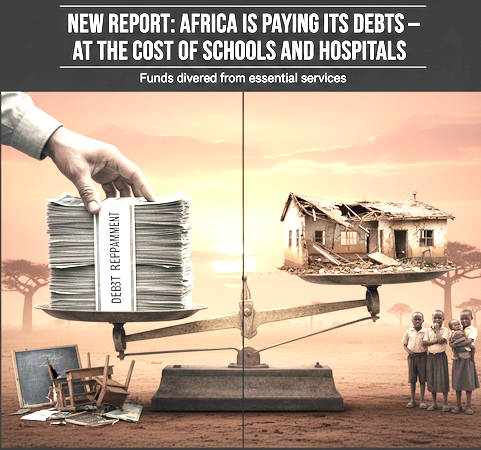
The same pattern appears in public finances. Governments are narrowing their budget deficits, which sounds like progress. But at the same time, they are spending more on debt repayments than on essential services like health and education. In practical terms, that means money that could build schools or hospitals is instead going to service loans.
The report captures this tension clearly: Africa’s economic stability is “holding—but only just.”
What makes this moment more fragile is the risk of new external shocks. The ongoing conflict in the Middle East, for example, is already pushing up oil and fertiliser prices. For African economies, that doesn’t just mean higher fuel costs. It means more expensive food, since fertiliser shortages today can reduce harvests tomorrow. The result is what the report describes as a combined energy and food shock, one that hits the poorest households first and hardest.
There is, however, a growing recognition that the solution lies not in quick fixes, but in deeper structural change. Industrial policy, long seen as a path to transformation, is making a comeback across the continent. But the report cautions against easy optimism.
The problem, it argues, is not that African countries lack ideas. It is that they struggle to implement them effectively. Policies are often too ambitious for existing capacity, too small to have meaningful impact, or disconnected from the broader systems they depend on, such as reliable electricity, transport, and skills.
This is what the report reframes as an “ecosystem” problem. Building factories or promoting industries is not enough if the surrounding conditions, power supply, logistics, and financing are weak or unreliable.
In that sense, Africa’s challenge is not choosing the right sectors. It is building the foundations that allow any sector to thrive.
The stakes are high. The report warns that the coming decade will determine whether Africa achieves real economic transformation or remains stuck in a cycle of low-productivity growth.
Because in the end, growth alone is not the goal. Transformation is. And without it, what looks like stability today may simply be a crisis deferred.