
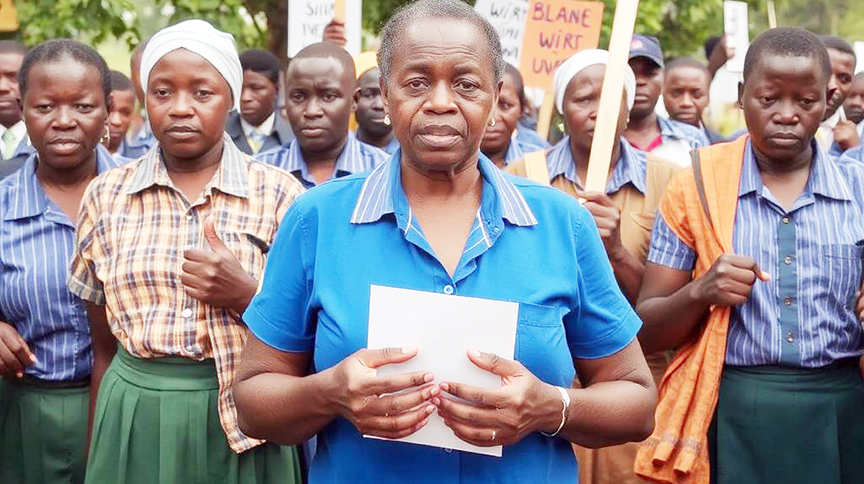
KAMPALA— In classrooms across Uganda, the chalkboards are silent, and the seats sit empty. Humanities teachers, tired of broken promises and deepening inequality, have downed their tools in protest. The national strike, led by the Uganda Professional Humanities Teachers Union (UPHTU), has brought teaching to a halt in government-aided secondary schools, primary teachers’ colleges, national teachers’ colleges, and Uganda colleges of commerce.
For these educators, the message is clear: equal work deserves equal pay.
A Long Wait, A Deeper Wound
“We’ve been promised a salary increment since 2018,” said Innocent Mugisha, a secondary school teacher from the Ankole region and UPHTU’s Assistant Regional Coordinator. His voice is firm, laced with years of disappointment. “We’ve been patient, but the government has ignored us.”
That patience finally wore thin in the aftermath of a 2022 decision to raise salaries for science teachers—a move that saw their monthly pay jump from Shs 1.2 million to Shs 4 million. Meanwhile, their arts and humanities colleagues were left behind, still earning as little as Shs 900,000—an amount barely sufficient to meet the rising cost of living.
“The cost of living is the same for all of us,” Mugisha noted. “We even buy the same food, ride the same boda-bodas. Why should we earn less for the same work?”
Adding to the strain is the implementation of a new curriculum, which has increased workload and complexity for all teachers, regardless of subject. “It’s tedious for everyone,” he said.
Another teacher, who preferred to remain anonymous, echoed Mugisha’s frustration. “The government created a huge gap between arts and science teachers’ salaries,” she said, her voice breaking. “We use the same chalk, the same teaching methods. We stay up late marking papers just like they do. Why are our salaries so meager while they earn handsomely?”
For many, the pay raise for science teachers felt less like progress and more like betrayal. “We all serve the same students. Why are we treated so differently?” she asked.
A System on Pause
The strike has paralyzed Uganda’s public teacher training institutions and secondary education sector. Lecture halls are empty, chalkboards untouched, and thousands of students sent home. In contrast, private schools remain in operation, drawing attention to widening disparities within the education system.
At the heart of the matter lies a pay gap that extends well beyond the classroom. In administrative roles, the divide is even starker: science deputy headteachers earn Shs 5.5 million, while their humanities counterparts make just Shs 1.5 million. For headteachers, the gulf is even wider—Shs 6.5 million versus Shs 2.3 million.
Voices from the Frontlines
UPHTU National Chairperson Teopista Akello has emerged as a leading voice in the strike, rallying educators across the country.
“We demand uniform salary scales for all teachers with equivalent qualifications, regardless of subject,” she declared at a mass gathering of striking educators. “We won’t return until our grievances are addressed.”
Her words have galvanized not only classroom teachers but also headteachers and support staff, who see this moment as a pivotal fight for fairness and dignity in their profession.
A Deafening Silence from Government
The government has offered little in the way of resolution. During the 2024 World Teachers’ Day celebration at Lugogo Cricket Oval, President Museveni defended the science teacher salary increase as a strategic move, citing limited resources and the need to prioritize science and technology.
But humanities teachers aren’t convinced.
“They call science a priority, but what about us?” Mugisha asked. “Don’t our subjects shape critical thinkers, leaders, and citizens too?”
Since the strike began, the government’s continued silence has only deepened the frustration, with many teachers now wondering not just when their pay will be adjusted but whether their contributions are seen at all.
A Fight for Recognition, Not Just a Raise
This is more than a salary dispute. It’s about value, respect, and the future of Uganda’s education system. The teachers striking today are the ones who shape the country’s writers, lawyers, historians, and civic leaders. Their classrooms are where students learn how to analyze, question, and engage with the world.
By demanding equal pay, humanities teachers are making a broader call: to recognize that every subject, every educator, and every student matters.
The chalk may be down for now, but the writing is on the wall—and it speaks of a profession standing tall in the face of disregard, asking not for favor, but for fairness.