
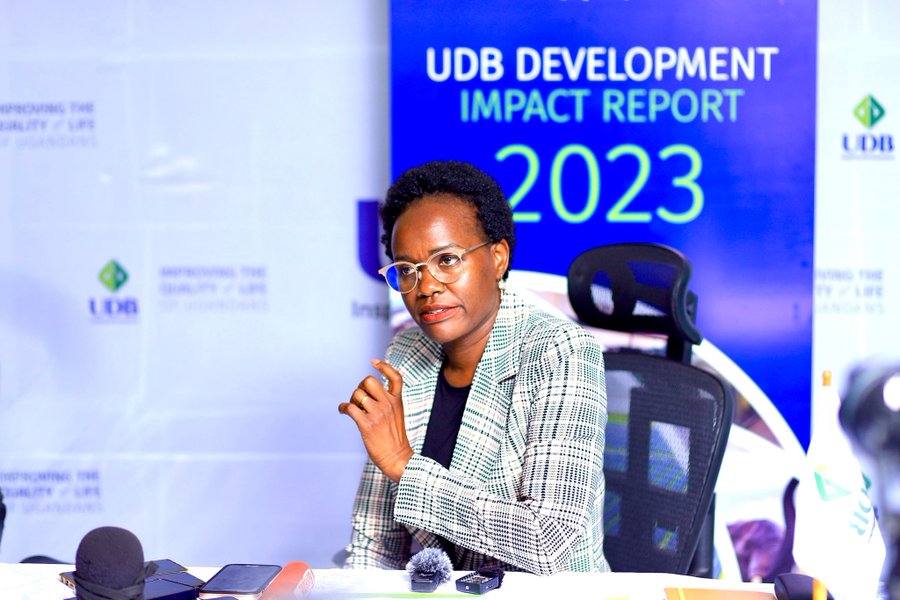
KAMPALA – In 2023, the Uganda Development Bank (UDB) continued its mission of spurring socio-economic development, focusing on job creation, wage growth, and tax revenue contribution. Through its financing of various sectors, UDB played a critical role in maintaining and creating jobs across the country, improving livelihoods, and increasing the country’s tax base. A closer analysis of UDB’s 2023 Development Impact Report reveals significant trends in employment, income distribution, and tax revenue contributions, while also highlighting challenges in certain sectors.
Job Creation: Primary Agriculture Leads, But Declines in Key Sectors
Job creation remains a core measure of UDB’s effectiveness in driving economic growth. In 2023, UDB-supported projects created and maintained 51,841 jobs, a slight increase from 51,439 in 2022. Of the total jobs, 3,959 were new jobs, with 27.6 percent of those generated through Special Programs (SP), an initiative aimed at accelerating job creation through targeted projects.
One of the most significant findings was that the primary agriculture sector contributed 39 percent of the total jobs created, solidifying its status as the largest employer among UDB-financed projects. Agriculture is inherently labor-intensive, and UDB’s support to this sector aligns with the country’s agricultural backbone, employing the largest share of Uganda’s workforce. On average, enterprises in this sector created 157 jobs each, showcasing its immense potential for absorbing labor.
However, the report also pointed to declines in job creation across several sectors. Manufacturing, which is vital to Uganda’s industrialization strategy, experienced a significant 53 percent drop in jobs created. The education sector saw a 13 percent decline, while primary agriculture had a 9 percent reduction in jobs. This dip in job creation in sectors such as manufacturing and education could be attributed to operational challenges, limited investment, or shifts in market demand, underscoring the need for strategic interventions to rejuvenate employment in these critical areas.
Wage Disparities: Agriculture Workers Earn Below Poverty Line
While UDB has made strides in job creation, wage disparities across sectors remain a pressing issue. The report highlights that 34 percent of employees in UDB-supported enterprises earned less than UGX 210,000 per month, which is equivalent to less than USD 1.98 per day—placing them below the international poverty line. The situation is particularly stark in the primary agriculture sector, where 65 percent of workers earned below this threshold. This reflects the low pay in sectors that require minimal formal education and are labor-intensive, resulting in a large pool of workers willing to accept lower wages.
Despite these challenges, there was a notable improvement compared to 2022, where 80 percent of employees in agriculture earned below UGX 210,000. This represents a 15-percentage point improvement, suggesting that UDB’s interventions are gradually enhancing income levels for workers. However, more needs to be done to raise wages, particularly in sectors like agriculture, to ensure that more workers can escape poverty and contribute to economic growth through increased consumer spending.
In contrast, sectors such as health, agro-processing, and manufacturing offered relatively higher wages, with 33 percent of employees earning between UGX 210,000 and UGX 420,000, while 8 percent of employees under special programs earned above UGX 420,000. These higher-paying sectors require more specialized skills, which explains the relatively better compensation for workers compared to labor-intensive sectors like agriculture.
Tax Revenue Contribution: A Significant 60% Increase
In 2023, UDB-supported enterprises contributed UGX 236.08 billion in direct taxes, a significant 60 percent increase from UGX 147.5 billion in 2022. This sharp rise in tax revenue is a testament to the success of UDB’s investments in sectors that generate high economic output. Direct taxes, as the name suggests, are taxes paid directly to the government by individuals or entities, such as corporation tax (profits) and Pay As You Earn (PAYE) taxes on employee earnings.
Corporation tax accounted for 82 percent of the total tax contribution, reflecting the profitability of UDB-supported businesses. Pay As You Earn taxes made up the remaining 18 percent, showcasing the importance of job creation and wage growth in boosting government revenue. Manufacturing led the way with 47 percent of the total tax contribution, followed by agro-processing at 27.9 percent, and primary agriculture at 15 percent. The high tax contribution from manufacturing can be attributed to its large-scale operations, significant investment in equipment, and higher employment of skilled workers, which increases the tax base.
Breaking Down Key Concepts
Special Programs (SP) refer to targeted interventions by UDB aimed at accelerating job creation and economic impact in specific sectors or regions. This initiative focuses on high-impact projects that drive employment and economic growth.
Direct taxes are payments made by individuals or entities directly to the government, as opposed to indirect taxes like VAT. Examples include corporation tax and PAYE, both of which played a significant role in Uganda’s revenue generation in 2023.
An ex-post assessment is an evaluation carried out after a project or program has been implemented, assessing its actual impacts against the intended outcomes. UDB’s ex-post assessment for 2023 examined employment, wage distribution, and tax contributions to determine the effectiveness of its financing initiatives.
The Broader Economic Impact
UDB’s continued support to sectors like agriculture, agro-processing, manufacturing, and health demonstrates its pivotal role in Uganda’s economic transformation. By creating jobs, improving incomes, and boosting tax revenue, UDB plays a crucial role in addressing some of the country’s most pressing socio-economic challenges. However, the wage disparities highlighted in the report, especially in the agriculture sector, call for continued efforts to ensure that more Ugandans earn decent wages and enjoy a better quality of life.
As Uganda looks to 2024, addressing these disparities, revitalizing job creation in struggling sectors, and sustaining tax revenue growth will be key priorities for UDB and policymakers alike. With strategic investments and a focus on inclusive growth, UDB remains central to Uganda’s path toward sustainable development.