
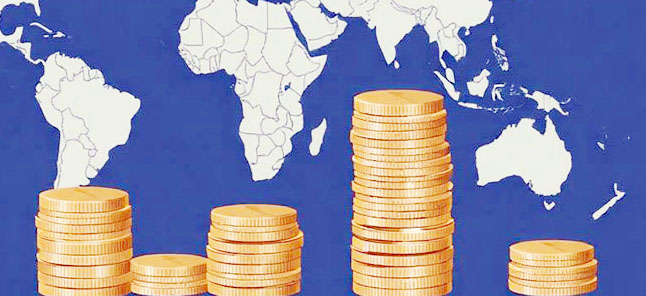
How does the international system actually work? We often hear about “global cooperation” and “development aid,” but when you peel back the diplomatic layer, a much more lopsided reality emerges. New research by Paula Druschke and Gastón Nievas, spanning a century of data from 1920 to today, reveals a global public system that functions less like a democracy and more like a private club with very high membership fees for the poor.
For a country like Uganda, these aren’t just academic findings, they are the invisible forces that dictate everything from the interest rates on our national debt to the speed of our infrastructure projects.
Both Paula Druschke and Gastón Nievas, who authored the research titled The Global Democratic Deficit: Undemocratic International Institutions Favor Powerful Countries—and Shape Who Pays and Who Benefits, are affiliates of the World Inequality Lab at the Paris School of Economics.
Why Africa Pays More for Less
In most of the world’s most powerful financial institutions, like the International Monetary Fund (IMF) and the World Bank, influence is essentially “for sale.” Voting rights are tied directly to how much money a country contributes. On the surface, this sounds logical: those who pay more should have more say.
However, the research reveals a staggering “regressive” tax on influence. Richer countries actually acquire their voting power at a much lower relative cost than poorer ones. Consider this: the G7 nations (the world’s wealthiest economies) hold 41 percent of the IMF’s voting power. When you add other wealthy nations, that figure jumps to 70 percent.
To put this in perspective for a non-technical reader: if a country like Uganda wanted to match the voting power of a wealthy nation that contributes 1 percent of its wealth (GDP), Uganda would have to hand over a massive 26 percent of its entire economy. In simpler terms, for every dollar a rich country spends to buy a “vote” in global affairs, a poor country has to spend 26 times more of its available income just to keep up. It is a system where the “entry fee” for the poor is prohibitively, and perhaps intentionally, high.
The “Friends and Family” Plan
This concentration of power doesn’t just affect who speaks; it affects who gets paid. The study shows that in institutions where voting power is concentrated in a few wealthy hands, money flows toward “friends.”
The data reveals a stark and systemic bias in how global resources are distributed. At the World Bank, roughly 70 percent of all lending is directed toward countries geopolitically aligned with the G7 nations. The situation at the IMF is even more extreme, where approximately 67 percent of loans flow to G7-aligned partners, despite those nations representing a mere six percent of the world’s population and a tiny three percent of global economic activity.
By contrast, the United Nations General Assembly, which operates on a “one country, one vote” model, doesn’t show this kind of favoritism. When the system is more democratic, money tends to follow actual need rather than political loyalty. For African nations that try to maintain independent foreign policies, this “global democratic deficit” can mean being bypassed for critical financing in favor of more “compliant” partners.
A System by Design, Not Necessity
The most important takeaway from this century-long study is that these patterns are not inevitable. They aren’t a law of nature or an economic necessity; they are the result of institutional design. We are living with a system where those who face the lowest cost to acquire influence obtain the greatest power, contribute the least relative to their income, and then steer resources toward their own partners, the research found. This creates a cycle of inequality that harms developing countries the most.
The Path Forward: Fairness as Effectiveness
Reforming how the world is governed isn’t just about “being nice” to Africa or the Global South; it’s about making the system actually work. When power is too concentrated, the system loses its legitimacy.
The researchers suggest several sharp departures from the status quo to address these systemic imbalances. First, the global community must drop GDP-weighted formulas that automatically grant more power to countries simply because they are already wealthy. Furthermore, we should embrace proven alternatives, as the stark contrast between the IMF and the UN demonstrates that more democratic governance is entirely feasible. Ultimately, international cooperation is only credible when contributions are aligned with outcomes, ensuring that the people most affected by global policies finally have a seat at the table where those decisions are made.
For Uganda and its neighbors, the message is clear: the current “rules-based order” was designed when much of Africa was still under colonial shadow. If we want a global system that can survive the 21st century, the engine itself needs a total overhaul.