
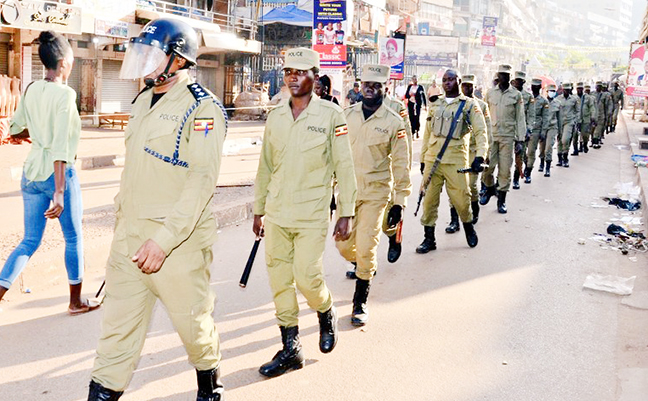
KAMPALA – As Uganda’s election season winds down, a quieter transition is underway, one that will shape the country’s security landscape long after ballots are counted.
More than 90,000 election police constables, recruited and trained specifically to secure the recent general elections, are set to be decommissioned. For many of them, mostly young men and women, this moment has always carried a familiar anxiety: what comes next?
On Tuesday, the Inspector General of Police, Abbas Byakagaba, offered an answer.
Meeting the executive leadership of the Uganda Private Security Association (TUPSA) at police headquarters in Naguru, Byakagaba urged private security companies to absorb election constables who wish to continue working in security once their election duties formally end.
If implemented fully, the move could see more than 99,000 former election constables transition into private security, addressing both looming unemployment and a long-standing labour shortage in the private security sector.
“These private security organisations are force multipliers,” Byakagaba said, describing them as a “service to the nation,” even though they operate as private businesses. He noted that the sector plays a critical role in supplementing the police, especially as demand for security continues to grow.
To support the transition, the police will open up their regional training camps to private security organisations. The Uganda Police Force will also provide logistical support, including training facilities, clothing, food, transport, and medical services.
Byakagaba said this government-backed support is meant to professionalise private security services while reducing the high cost of training, one of the sector’s biggest barriers to growth. Lower training costs, he added, could also ease pressure on the police from influential individuals who frequently request personal police protection.
“Private security organisations are an attachment to the police,” he said, noting that government regulation of the sector reflects its importance to national security.
He directed the formation of a joint committee to work out training arrangements, beginning with the retraining of election constables before expanding to current and future private security guards.
For the private security industry, the announcement was warmly received.
Grace Matsiko, who led the TUPSA delegation, described the offer as a “strategic intervention” by the police and government. He said it builds on existing support extended to private security companies, including assistance with the procurement of firearms.
TUPSA members present at the meeting thanked the police leadership and called on other private security organisations to quickly submit the number of election constables they intend to recruit.
Beyond institutional reform, the shift carries a deeply human dimension.
Election constables are largely young, energetic Ugandans hired on short-term contracts tied to the election cycle. Once voting ends, many face sudden unemployment. Absorbing them into private security offers not just continuity of income, but a pathway to formalised, regulated work.
Still, the move also raises broader questions about oversight, training standards, and the expanding role of private security in public life, questions that will become more pressing as private guards increasingly operate alongside the state.
As Uganda navigates the aftermath of another election, the fate of its election constables offers a glimpse into how the country manages temporary public workers, youth employment, and the blurred line between public policing and private security.
For thousands of young Ugandans, the transition from polling stations to guard posts may soon begin, not as an ending, but as a second deployment in a security system learning to adapt to its own scale.